
IGCSE Biology | Plant Nutrition
1. What is Photosynthesis? #
Plants use simple raw materials — carbon dioxide from the air and water from the soil — and light energy to make their own food. Photosynthesis happens mainly in the leaves.
2. Chlorophyll and Chloroplasts #
Chloroplasts are small structures found in plant cells, mostly in leaf cells. The green colour you see in plant leaves comes from chlorophyll. Chlorophyll absorbs light energy and converts it into chemical energy, which is stored in glucose and other carbohydrates.
3. The Photosynthesis Equation #
Word Equation #
carbon dioxide + water → glucose + oxygen
(using light energy and chlorophyll)
Balanced Chemical Equation #
This equation shows that six molecules of carbon dioxide and six molecules of water are needed to make one molecule of glucose and six molecules of oxygen.
4. How Plants Use the Carbohydrates Made #
Glucose is the first product of photosynthesis, but plants convert it into other carbohydrates depending on what they need:
| Carbohydrate | How it is used |
|---|---|
| Starch | Stored as an energy store in leaves, roots, and seeds. Starch is insoluble, so it does not affect the water balance inside cells. |
| Cellulose | Used to build cell walls. Cellulose makes the walls strong and gives the plant its shape and support. |
| Glucose | Used in respiration to release energy for the plant’s own life processes (growth, movement of substances, etc.). |
| Sucrose | Transported through the plant via the phloem. Sucrose is a soluble sugar that is easy to move from leaves to other parts of the plant. |
5. What Plants Need for Photosynthesis #
Photosynthesis requires three things: chlorophyll, light, and carbon dioxide. We can test for each using controlled experiments.
All experiments check whether starch has been made using the iodine test: blue-black colour = starch present (photosynthesis happened); orange-brown = no starch (photosynthesis did not happen).
Use a variegated leaf (green and white patches). Only the green parts contain chlorophyll. After leaving the plant in light, test the whole leaf for starch.
Result: Only the green parts turn blue-black. The white parts (no chlorophyll) stay orange-brown.
Conclusion: Chlorophyll is needed for photosynthesis.
Control: Keep all other conditions (light, CO₂, temperature) the same for the whole leaf.
Cover part of a leaf with black card or foil to block light. Leave the plant in normal conditions, then test the whole leaf for starch.
Result: The uncovered part turns blue-black. The covered part stays orange-brown.
Conclusion: Light is needed for photosynthesis.
Control: Both parts of the leaf must have the same chlorophyll, CO₂, and temperature — only light is different.
Place a plant in a sealed container with soda lime, which absorbs all CO₂ from the air. A second plant is placed in a similar container without soda lime (the control). Both are kept in light.
Result: The plant without CO₂ (with soda lime) shows no starch. The control plant shows starch.
Conclusion: Carbon dioxide is needed for photosynthesis.
6. Factors Affecting the Rate of Photosynthesis #
The rate of photosynthesis is how fast a plant photosynthesises. Three main factors affect this rate:
Light Intensity #
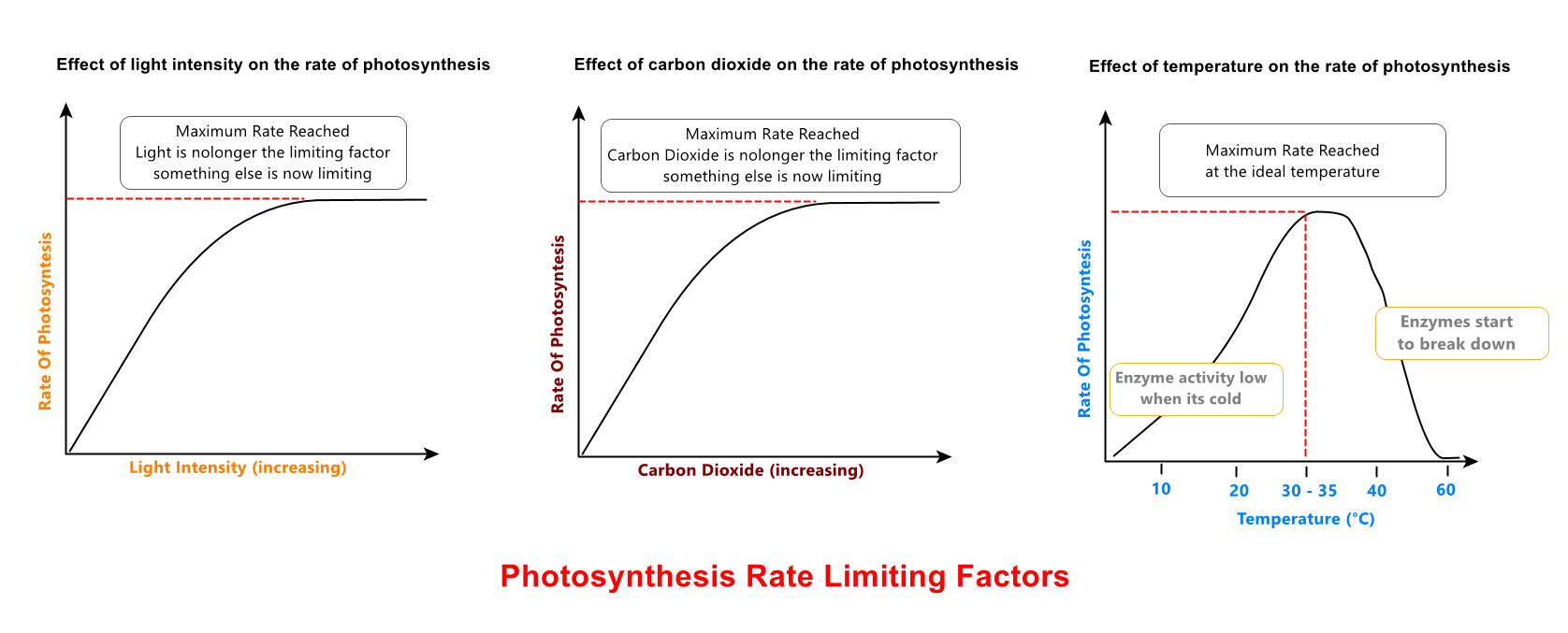
As light intensity increases, the rate of photosynthesis increases. This is because more light energy is available for chlorophyll to absorb. However, the rate eventually levels off — increasing light further has no effect because something else (such as CO₂ or temperature) becomes the factor holding it back.
Carbon Dioxide Concentration #
As CO₂ concentration increases, the rate of photosynthesis increases, because CO₂ is a raw material. Again, the rate levels off when another factor becomes limiting.
Temperature #
As temperature increases, the rate of photosynthesis increases — up to an optimum temperature (around 25–30°C for most plants). Beyond this point, the enzymes that control photosynthesis begin to denature (lose their shape), so the rate drops sharply.
7. Investigating Photosynthesis #
Method 1 — Submerged Aquatic Plants (e.g. Elodea) #
Aquatic plants like Elodea release oxygen bubbles when they photosynthesise. By counting the number of bubbles per minute, we can measure the rate of photosynthesis.
- Place a piece of Elodea in a beaker of water.
- Place a lamp at a fixed distance and count the oxygen bubbles produced per minute.
- Change one variable at a time (e.g. move the lamp closer to increase light intensity).
- Keep all other variables constant (temperature, CO₂ level, same piece of plant).
Result: More bubbles per minute = faster rate of photosynthesis.
Method 2 — Hydrogencarbonate Indicator #
Hydrogencarbonate indicator changes colour depending on the amount of CO₂ in the water. It can show whether a plant is photosynthesising (using up CO₂) or not.
(CO₂ has increased — acidic)
(starting colour)
(CO₂ has decreased — plant is photosynthesising)
To test the effect of light: set up sealed test tubes with the indicator and a water plant. Place one in light and one in the dark. The one in light will turn purple (CO₂ used up by photosynthesis). The one in the dark will turn yellow (CO₂ increases from respiration only).
8. Limiting Factors #
Even if you increase light intensity, the rate will not increase if CO₂ or temperature is already the limiting factor. You must identify and improve the correct factor.
| Environmental Condition | Likely Limiting Factor |
|---|---|
| Dim light (e.g. winter, shaded area) | Light intensity |
| Low CO₂ in a sealed space | Carbon dioxide concentration |
| Cold conditions (e.g. early morning, cold climate) | Temperature |


