
IGCSE Biology | Plant Nutrition
1. Why Leaf Shape is an Adaptation for Photosynthesis #
Most leaves share two important physical features: they are large and flat, and they are thin. These are not accidents — they are adaptations that help the leaf photosynthesise as efficiently as possible.
| Feature | Why it is an adaptation |
|---|---|
| Large, flat surface area | Captures more light energy. A larger surface means more chloroplasts can be exposed to sunlight at once, increasing the rate of photosynthesis. |
| Thin | Carbon dioxide only has to travel a short distance from the stomata to reach the mesophyll cells where photosynthesis happens. Short diffusion distances mean faster gas exchange. |
2. Overview: Layers of a Dicotyledonous Leaf #
A dicotyledonous leaf (the type of leaf found on most flowering plants, such as bean or sunflower plants) has several distinct layers. Each layer has a specific structure that makes it suited to its job.
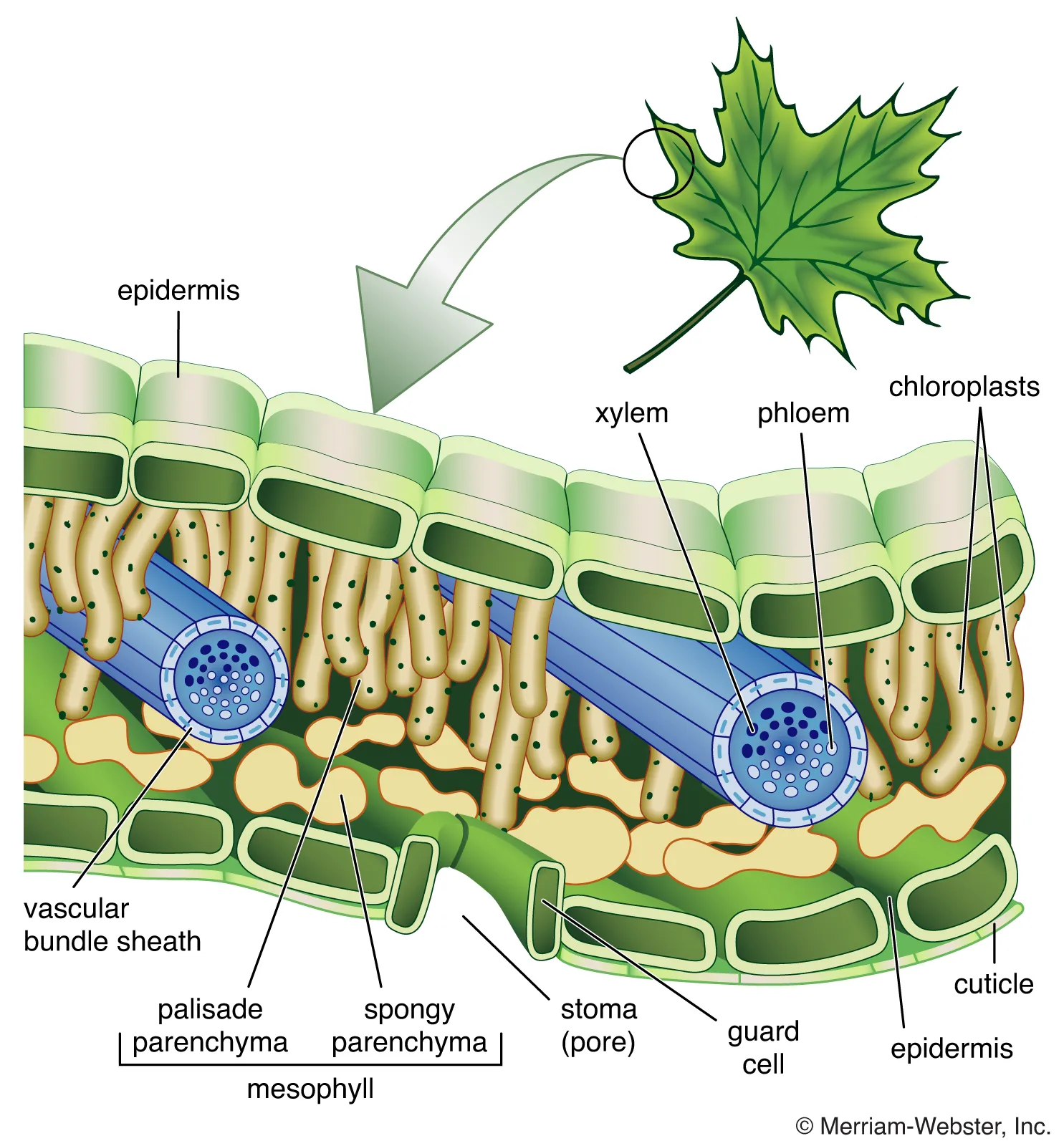
From top to bottom, the layers are:
- Waxy cuticle (top)
- Upper epidermis
- Palisade mesophyll
- Spongy mesophyll (with air spaces)
- Lower epidermis (with stomata and guard cells)
- Waxy cuticle (bottom)
Vascular bundles run through the leaf as veins.
3. Leaf Structures and Their Adaptations #
Cuticle #
The cuticle is a thin, waxy, transparent layer that covers the upper and lower epidermis. Because it is transparent, light can pass through it easily to reach the cells below. The waxy coating reduces water loss through the leaf surface (evaporation).
Upper and Lower Epidermis #
The epidermis is a single layer of flat cells that covers the top and bottom of the leaf. Epidermal cells are transparent and contain no chloroplasts. This allows sunlight to pass straight through to the mesophyll cells below, where most photosynthesis takes place.
The lower epidermis contains the stomata (small pores), which allow gases to enter and leave the leaf.
Palisade Mesophyll Cells #
These are tall, column-shaped cells packed tightly together just below the upper epidermis. They contain a large number of chloroplasts and are positioned near the top of the leaf, close to the light source.
Spongy Mesophyll Cells #
These cells are found below the palisade layer. They are irregularly shaped and loosely arranged, with large gaps between them. They contain fewer chloroplasts than palisade cells.
Air Spaces #
Air spaces are the gaps between the spongy mesophyll cells. They are connected to the stomata, so gases can diffuse in and out of the leaf easily.
Stomata and Guard Cells #
Stomata (singular: stoma) are tiny pores found mainly on the lower epidermis of the leaf. Each stoma is surrounded by two guard cells, which control whether the pore is open or closed.
- When guard cells absorb water, they swell and curve outward — the stoma opens.
- When guard cells lose water, they straighten — the stoma closes.
Vascular Bundles (Xylem and Phloem) #
Vascular bundles form the veins visible in a leaf. Each bundle contains two types of tissue:
- Xylem — carries water and dissolved minerals from the roots up to the leaf. Water is needed as a raw material for photosynthesis.
- Phloem — carries the sugars (mainly sucrose) produced by photosynthesis away from the leaf to the rest of the plant.
Distribution of Chloroplasts #
Chloroplasts are not spread evenly through the leaf. Most are found in the palisade mesophyll cells, which are at the top of the leaf where light intensity is greatest. Some are also found in the spongy mesophyll cells. The epidermis and cuticle contain no chloroplasts.
4. Quick Reference: Structures and Adaptations #
| Structure | Adaptation for Photosynthesis / Gas Exchange |
|---|---|
| Large, thin leaf | Large surface area captures more light; thin leaf = short diffusion distance for CO₂ |
| Cuticle | Transparent (lets light through); waxy (reduces water loss) |
| Epidermis | Transparent, no chloroplasts — allows light to pass to mesophyll below |
| Palisade mesophyll | Packed with chloroplasts; near the top for maximum light absorption |
| Spongy mesophyll | Loosely arranged cells create large air spaces for gas movement |
| Air spaces | Allow CO₂ and O₂ to diffuse freely through the leaf |
| Stomata & guard cells | Stomata allow gas exchange; guard cells control opening to limit water loss |
| Xylem | Delivers water to leaf cells for photosynthesis |
| Phloem | Removes sugars made by photosynthesis and transports them to the rest of the plant |
| Chloroplast distribution | Concentrated in palisade cells at the top — positioned where light is strongest |
Syllabus Reference — 6.2 Leaf Structure #
- State that most leaves have a large surface area and are thin, and explain how these features are adaptations for photosynthesis
- Identify and label the cuticle, cellular and tissue structures of a dicotyledonous leaf, as seen in diagrams or photomicrographs, and explain how these structures are adaptations for photosynthesis and gas exchange, limited to:
- stomata and guard cells
- spongy and palisade mesophyll cells
- air spaces
- vascular bundles (xylem and phloem)
- distribution of chloroplasts
- upper and lower epidermis


