
Table of Contents
IGCSE Mathematics | Core Topic
1. What is an Index? #
Definition
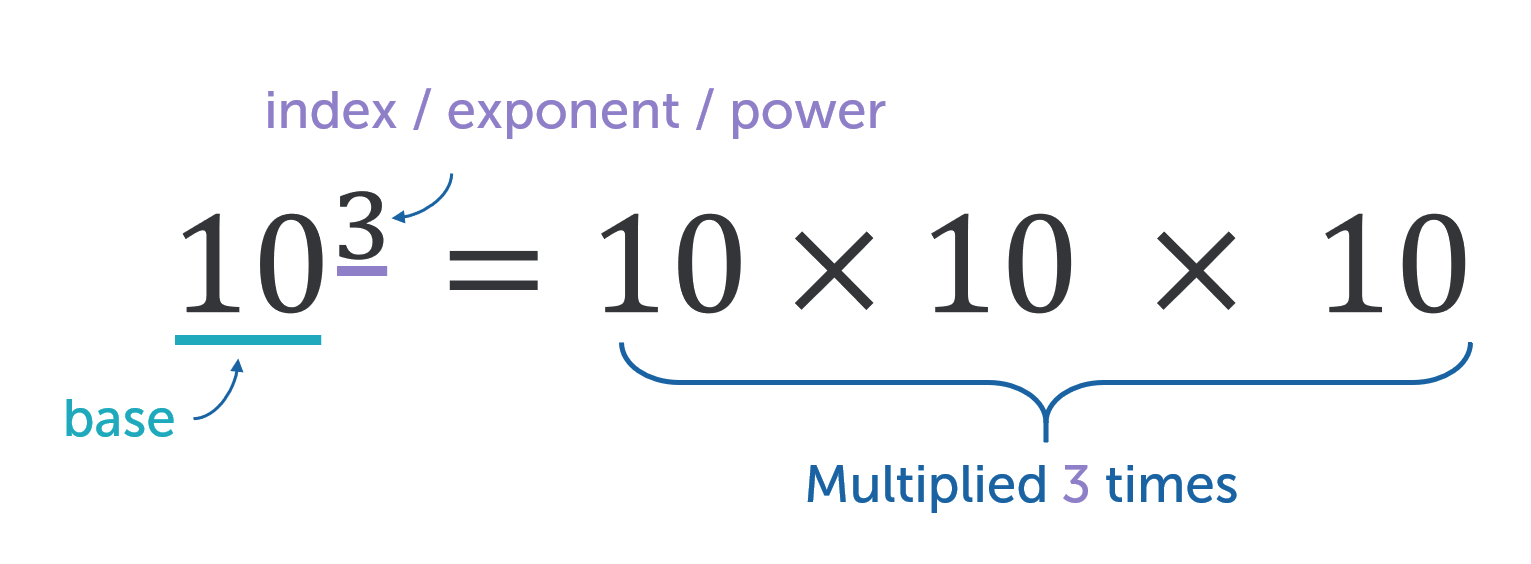
An index (also called a power or exponent) tells you how many times a number is multiplied by itself.
$$a^n = \underbrace{a \times a \times a \times \cdots \times a}_{n \text{ times}}$$
The number $a$ is called the base. The number $n$ is called the index.
Examples with Positive Indices
- $2^3 = 2 \times 2 \times 2 = 8$
- $5^4 = 5 \times 5 \times 5 \times 5 = 625$
- $10^2 = 10 \times 10 = 100$
Note: $a^1 = a$ (any number to the power 1 is itself)
2. Zero and Negative Indices #
Zero Index #
Rule
Any number (except zero) raised to the power of 0 equals 1.
$$a^0 = 1$$
Examples: $\quad 5^0 = 1 \qquad 100^0 = 1 \qquad 7^0 = 1$
Negative Index #
Rule
A negative index means one divided by that power.
$$a^{-n} = \frac{1}{a^n}$$
Worked Example — Find the value of $7^{-2}$
- Apply the negative index rule: $\quad 7^{-2} = \dfrac{1}{7^2}$
- Calculate the denominator: $\quad 7^2 = 49$
- Write the answer: $\quad 7^{-2} = \dfrac{1}{49}$
Remember: A negative index does NOT make the answer negative. It means the reciprocal (1 over) of that power.
3. Rules of Indices #
When the base is the same, you can use these three rules to simplify expressions with indices.
| Rule | What to do | Formula |
|---|---|---|
| Multiply | Add the indices | $a^m \times a^n = a^{m+n}$ |
| Divide | Subtract the indices | $a^m \div a^n = a^{m-n}$ |
| Power of a power | Multiply the indices | $(a^m)^n = a^{m \times n}$ |
Rule 1 — Multiplying: Add the Indices #
Worked Example — Find the value of $2^{-3} \times 2^4$
- The base is the same (both are 2), so add the indices: $$2^{-3} \times 2^4 = 2^{-3+4} = 2^1$$
- Calculate: $\quad 2^1 = 2$
Rule 2 — Dividing: Subtract the Indices #
Worked Example — Find the value of $2^3 \div 2^4$
- The base is the same (both are 2), so subtract the indices: $$2^3 \div 2^4 = 2^{3-4} = 2^{-1}$$
- Apply the negative index rule: $$2^{-1} = \frac{1}{2^1} = \frac{1}{2}$$
Rule 3 — Power of a Power: Multiply the Indices #
Worked Example — Find the value of $(2^3)^2$
- Multiply the indices: $$(2^3)^2 = 2^{3 \times 2} = 2^6$$
- Calculate: $\quad 2^6 = 64$
Important: These rules only work when the bases are the same. You cannot apply them to expressions like $2^3 \times 5^4$ because the bases (2 and 5) are different.
4. Summary of Index Rules #
| Rule | Formula | Example |
|---|---|---|
| Positive index | $a^n = a \times a \times \cdots \times a$ | $3^4 = 81$ |
| Zero index | $a^0 = 1$ | $9^0 = 1$ |
| Negative index | $a^{-n} = \dfrac{1}{a^n}$ | $4^{-2} = \dfrac{1}{16}$ |
| Multiply (same base) | $a^m \times a^n = a^{m+n}$ | $3^2 \times 3^5 = 3^7$ |
| Divide (same base) | $a^m \div a^n = a^{m-n}$ | $5^6 \div 5^2 = 5^4$ |
| Power of a power | $(a^m)^n = a^{mn}$ | $(4^3)^2 = 4^6$ |


