
1.2 — Motion #
IGCSE Physics | Core & Supplement
1. Speed and Velocity #
Speed #
The formula for speed is:
$$v = \frac{s}{t}$$- $v$ = speed (m/s)
- $s$ = distance travelled (m)
- $t$ = time taken (s)
- Formula: $$v = \frac{s}{t}$$
- Given: $s = 150\ \text{m}$, $t = 5\ \text{s}$
- Substitute: $$v = \frac{150}{5}$$
- Answer: $$v = 30\ \text{m/s}$$
Velocity #
2. Average Speed #
When an object’s speed changes during a journey, use average speed:
$$\text{average speed} = \frac{\text{total distance travelled}}{\text{total time taken}}$$- Formula: $$\text{average speed} = \frac{\text{total distance}}{\text{total time}}$$
- Given: distance = 600 m, time = 2 min = 120 s
- Substitute: $$\text{average speed} = \frac{600}{120}$$
- Answer: $$\text{average speed} = 5\ \text{m/s}$$
3. Acceleration Supplement #
- $a$ = acceleration (m/s²)
- $\Delta v$ = change in velocity (m/s) — final velocity minus initial velocity
- $\Delta t$ = time taken (s)
- Formula: $$a = \frac{\Delta v}{\Delta t}$$
- Given: initial velocity = 10 m/s, final velocity = 30 m/s, $\Delta t$ = 5 s
- Change in velocity: $\Delta v = 30 – 10 = 20\ \text{m/s}$
- Substitute: $$a = \frac{20}{5}$$
- Answer: $$a = 4\ \text{m/s}^2$$
Deceleration #
- Formula: $$a = \frac{\Delta v}{\Delta t}$$
- $\Delta v = 5 – 20 = -15\ \text{m/s}$, $\Delta t = 3\ \text{s}$
- Substitute: $$a = \frac{-15}{3}$$
- Answer: $$a = -5\ \text{m/s}^2$$
The negative sign shows the car is decelerating (slowing down).
4. Distance–Time Graphs #
A distance–time graph shows how far an object has travelled over time. The shape of the line tells you how it is moving.
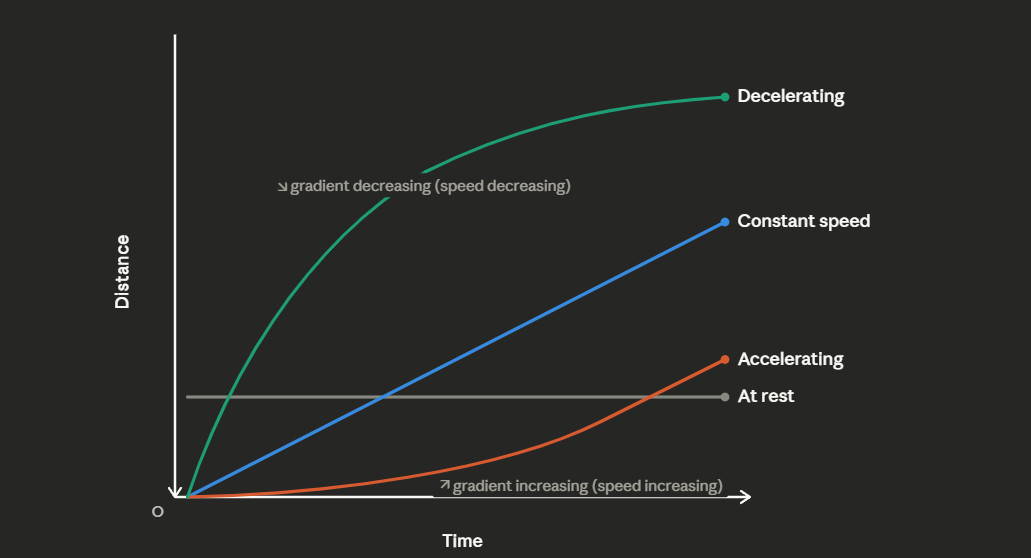
| Shape of Line | What it Means |
|---|---|
| Horizontal line | At rest — distance is not changing |
| Straight line sloping upward | Constant speed — equal distance in equal time |
| Curve getting steeper | Accelerating — speed is increasing |
| Curve getting less steep | Decelerating — speed is decreasing |
Calculating Speed from the Gradient #
The gradient (slope) of a straight-line section equals the speed of the object:
$$\text{speed} = \frac{\text{change in distance}}{\text{change in time}}$$- Formula: $$\text{speed} = \frac{\Delta s}{\Delta t}$$
- $\Delta s = 20 – 0 = 20\ \text{m}$, $\Delta t = 4 – 0 = 4\ \text{s}$
- Substitute: $$\text{speed} = \frac{20}{4}$$
- Answer: $$\text{speed} = 5\ \text{m/s}$$
5. Speed–Time Graphs #
A speed–time graph shows how the speed of an object changes over time.
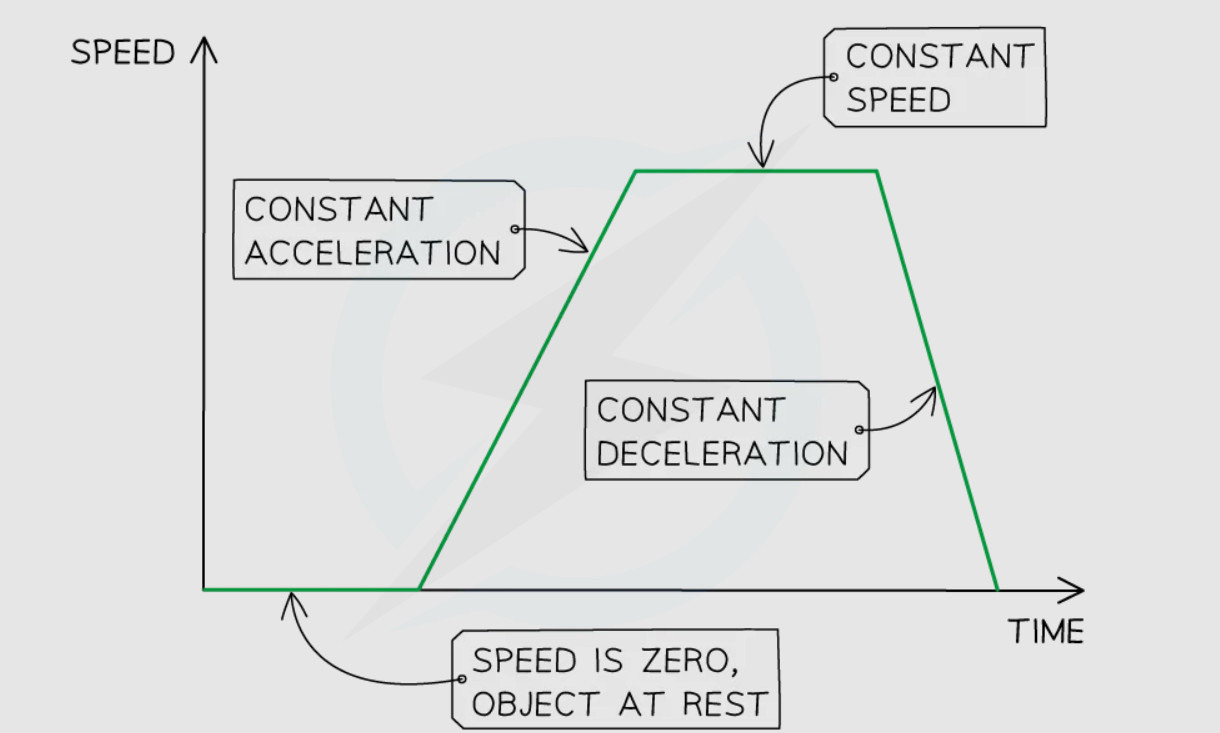
| Shape of Line | What it Means |
|---|---|
| Horizontal line at $v = 0$ | At rest |
| Horizontal line above zero | Constant speed |
| Line sloping up | Accelerating — speed is increasing |
| Line sloping down | Decelerating — speed is decreasing |
Calculating Distance from the Area #
The area under a speed–time graph equals the distance travelled.
- Shape under the graph: rectangle
- Area = width × height = $10 \times 6$
- Distance = $60\ \text{m}$
- Shape under the graph: triangle (speed starts at 0)
- $$\text{Area} = \frac{1}{2} \times \text{base} \times \text{height} = \frac{1}{2} \times 6 \times 12$$
- Distance = $36\ \text{m}$
Note: If the object does not start from rest, the shape is a trapezium. Use: $$\text{Distance} = \frac{1}{2} \times (v_1 + v_2) \times t$$ where $v_1$ and $v_2$ are the starting and ending speeds, and $t$ is the time.
Calculating Acceleration from the Gradient Supplement #
The gradient of a straight line on a speed–time graph equals the acceleration:
$$a = \frac{\Delta v}{\Delta t}$$- Formula: $$a = \frac{\Delta v}{\Delta t}$$
- $\Delta v = 14 – 4 = 10\ \text{m/s}$, $\Delta t = 5 – 0 = 5\ \text{s}$
- Substitute: $$a = \frac{10}{5}$$
- Answer: $$a = 2\ \text{m/s}^2$$
6. Free Fall #
Near the surface of the Earth, the acceleration due to gravity is approximately constant:
$$g \approx 9.8\ \text{m/s}^2$$This means a freely falling object speeds up by about 9.8 m/s every second.
7. Falling with Air Resistance — Terminal Velocity Supplement #
When a real object falls through air or a liquid, two forces act on it:
- Weight — pulls the object downward (constant)
- Air resistance (drag) — acts upward, opposing the motion
What Happens as the Object Falls #
- At the start, weight is greater than air resistance, so the object accelerates.
- As speed increases, air resistance increases.
- The acceleration decreases as the two forces get closer in size.
- Eventually, air resistance equals the weight. Net force = 0.
- The object reaches a constant speed called terminal velocity. It no longer accelerates.
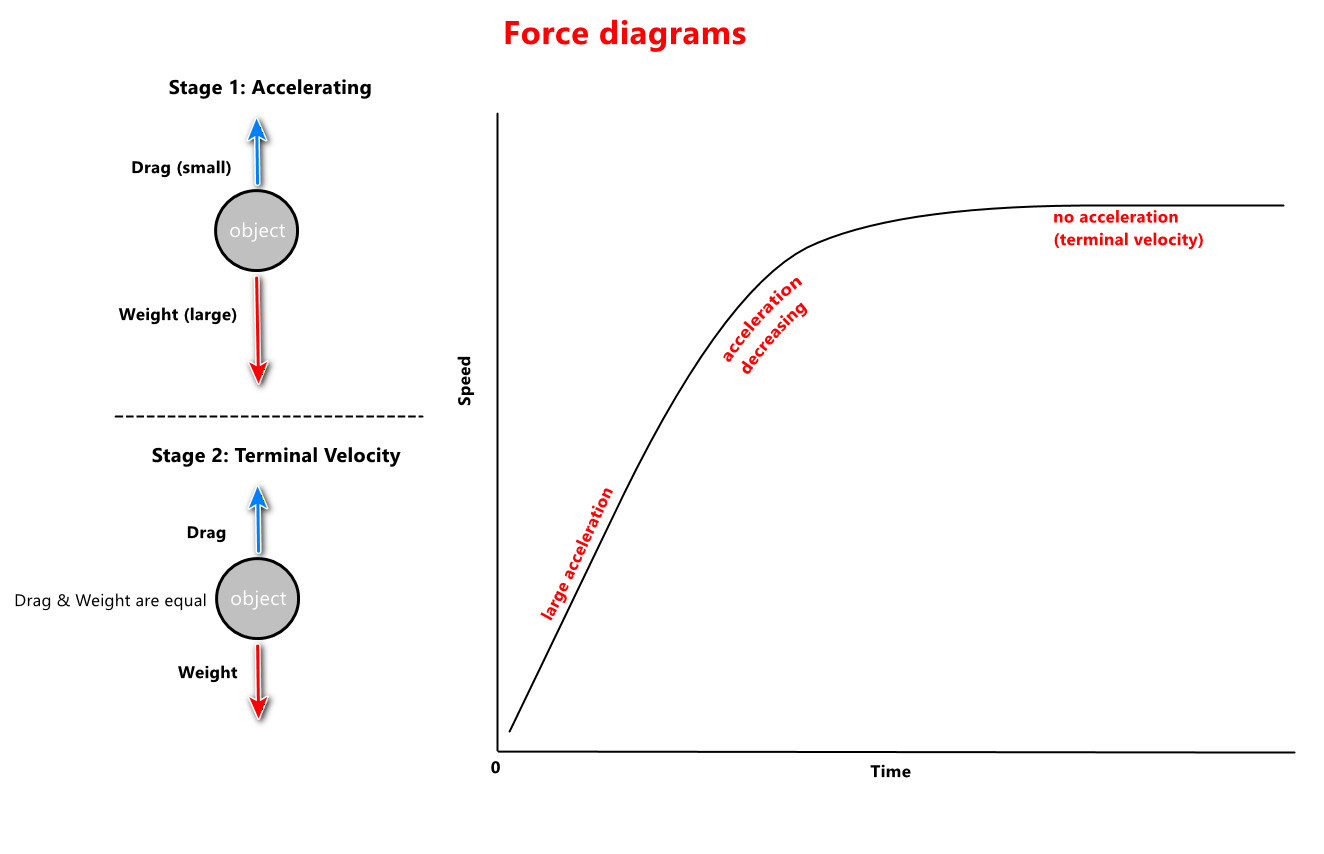
With air resistance: Acceleration decreases over time. The object eventually reaches terminal velocity and falls at constant speed.


