
- 1. Root Hair Cells — Absorbing Water and Minerals
- 2. The Pathway of Water: Root to Leaf
- 3. What is Transpiration?
- 4. Factors That Affect the Rate of Transpiration
- 5. How Water Moves Up the Xylem — Transpiration Pull
- 6. Structure of Xylem Vessels
- 7. Translocation — Moving Sugars and Amino Acids in the Phloem
- 8. Identifying Xylem, Phloem and Vascular Bundles in Cross-Sections
IGCSE Biology | Transport
1. Root Hair Cells — Absorbing Water and Minerals #
Plants absorb water and dissolved minerals (ions) from the soil through their root hair cells. These cells are specially adapted to do this job efficiently.
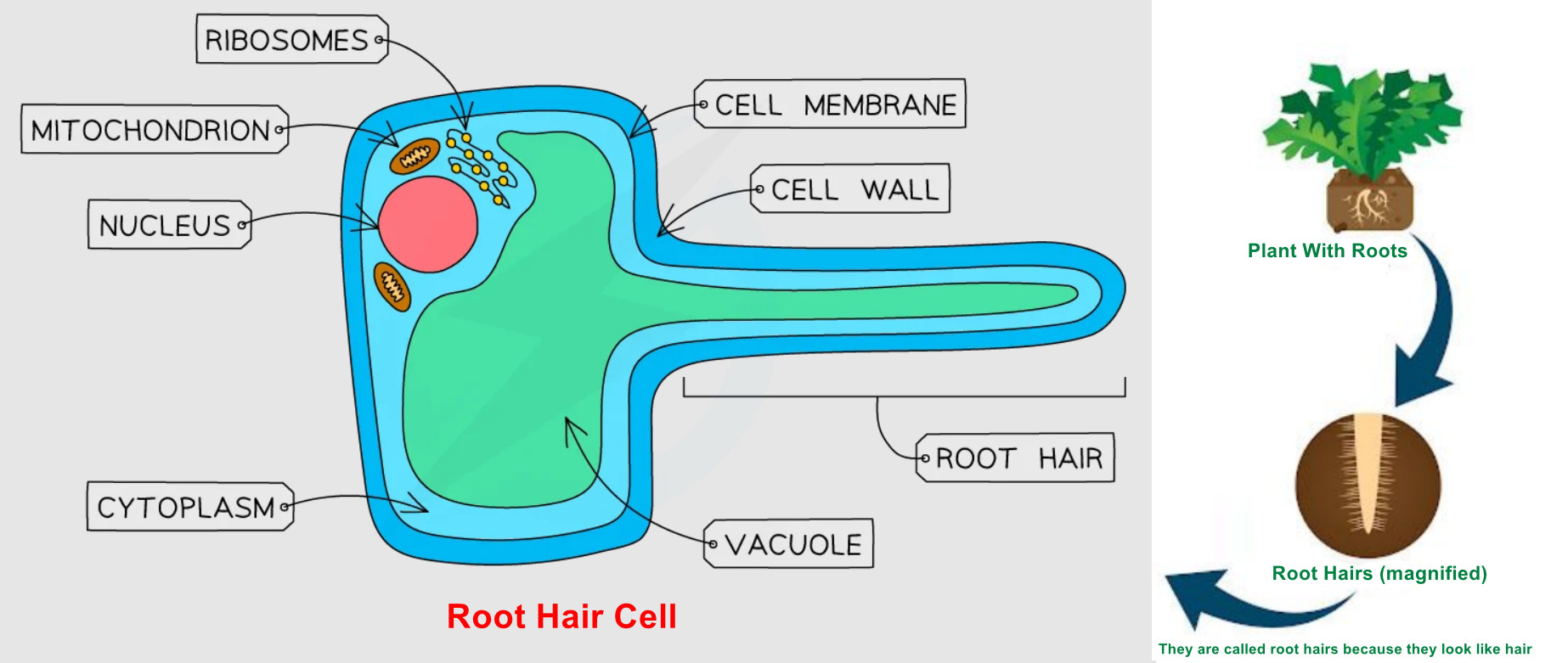
Structure of Root Hair Cells #
| Feature | How it helps absorption |
|---|---|
| Long, thin hair-like extension | Greatly increases the surface area in contact with soil water. A larger surface area means water and ions can be absorbed much faster. |
| Thin cell wall | Water does not have far to travel to enter the cell. This makes absorption faster. |
| Large vacuole | Contains cell sap with dissolved salts, which lowers the water potential inside the cell. This creates a concentration difference so water moves in by osmosis. |
How Water Enters #
Water moves into root hair cells by osmosis. The soil water has a higher water potential than the cell sap inside the root hair cell. Water therefore moves from the soil (high water potential) into the cell (lower water potential) through the partially permeable cell membrane.
How Minerals (Ions) Enter #
Mineral ions are absorbed by active transport. The concentration of ions inside the root is already higher than in the soil, so ions cannot enter by diffusion. Instead, the cell uses energy to pump ions in against the concentration gradient.
2. The Pathway of Water: Root to Leaf #
Once water enters the root hair cell, it travels through the plant in a specific route:
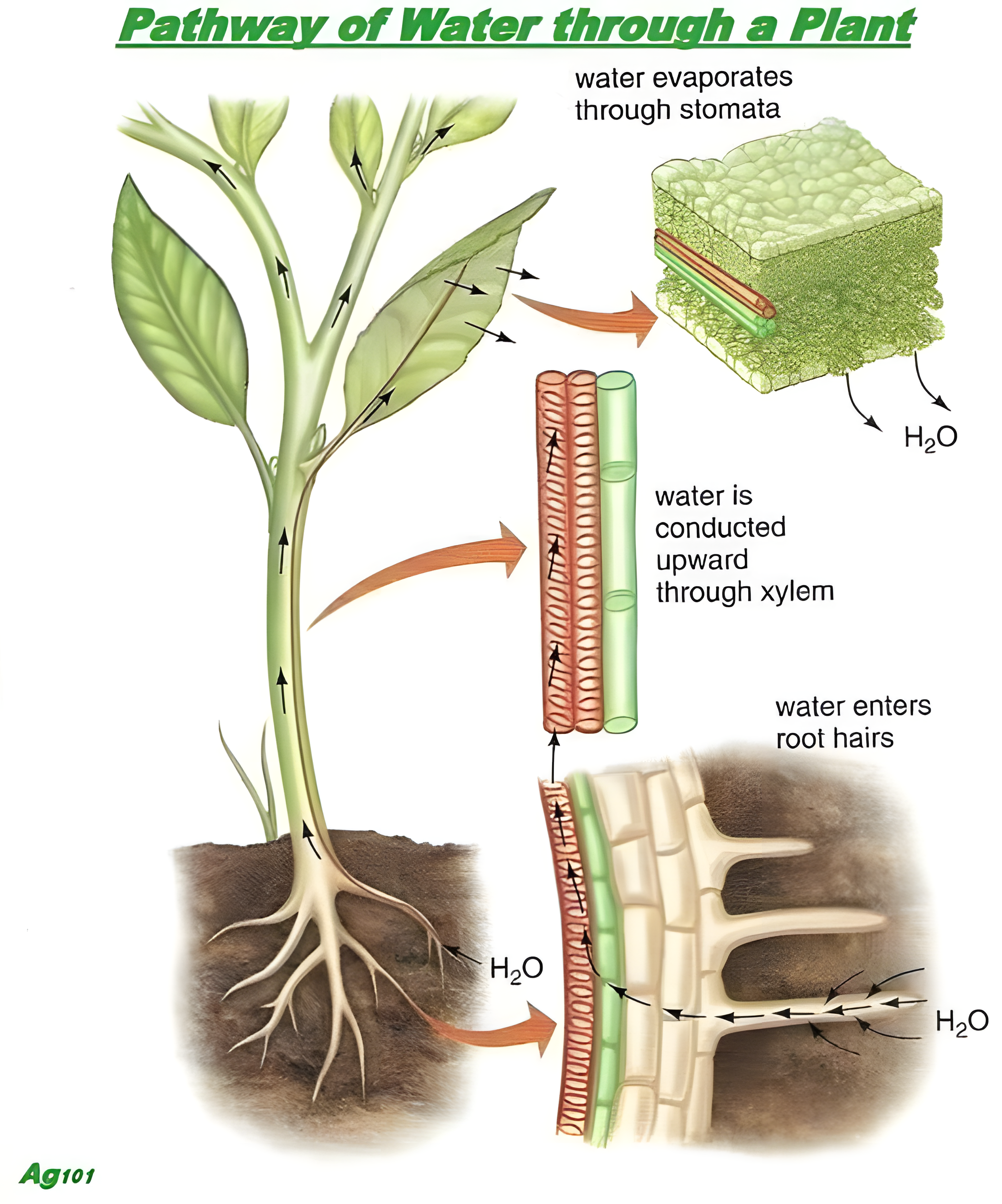
Step-by-Step Explanation #
- Root hair cells → Root cortex cells: Water moves from cell to cell across the cortex by osmosis. Each cell has a slightly lower water potential than the one before it, so water is pulled inward.
- Root cortex cells → Xylem: Water enters the xylem vessels in the centre of the root.
- Xylem in root → Xylem in stem → Xylem in leaf: Water travels up through continuous xylem tubes from root to stem to leaf.
- Xylem → Mesophyll cells: Water leaves the xylem and enters the mesophyll cells of the leaf.
- Mesophyll cells → Air spaces → Stomata: Water evaporates from the surface of mesophyll cells into the air spaces, then diffuses out of the leaf through the stomata as water vapour.
3. What is Transpiration? #
Here is what happens inside the leaf:
- Water evaporates from the wet surfaces of the mesophyll cells into the air spaces inside the leaf.
- This creates a high concentration of water vapour inside the leaf.
- The air outside the leaf usually has a lower concentration of water vapour.
- Water vapour diffuses out through the open stomata, down this concentration gradient.
Most transpiration happens through the stomata on the lower epidermis of the leaf, because that is where most stomata are found.
Why Wilting Occurs #
If a plant loses water faster than its roots can absorb it, the cells lose water and can no longer stay firm. The plant droops and becomes soft. This is called wilting. Wilting is a sign that the plant is losing too much water through transpiration.
4. Factors That Affect the Rate of Transpiration #
The rate of transpiration is how fast water vapour is lost from a plant. Several environmental factors affect this rate:
| Factor | Effect on transpiration rate | Reason |
|---|---|---|
| Wind speed | Higher wind speed → faster transpiration | Wind carries water vapour away from the leaf surface. This keeps the concentration of water vapour outside the leaf low, so the concentration gradient between inside and outside stays steep. Diffusion is therefore faster. |
| Humidity | Higher humidity → slower transpiration | Humid air already contains a lot of water vapour. This reduces the concentration difference between inside the leaf and the air outside. The gradient is less steep, so water vapour diffuses out more slowly. |
| Light intensity | Higher light intensity → faster transpiration | In light, stomata open wider to let CO₂ in for photosynthesis. Wider stomata allow more water vapour to escape, so transpiration speeds up. |
| Temperature | Higher temperature → faster transpiration | Warmer air holds more water vapour, and water molecules evaporate from mesophyll cells faster. This increases both the rate of evaporation and diffusion, so transpiration speeds up. |
5. How Water Moves Up the Xylem — Transpiration Pull #
Water has to travel from the roots all the way up to the leaves, sometimes many metres. It does this through the xylem. The mechanism that makes this happen is called the transpiration pull.
How it works, step by step: #
- Water evaporates from mesophyll cells and leaves through the stomata (transpiration).
- This causes the mesophyll cells to lose water. They then pull water from the xylem in the leaf veins.
- This creates a pulling force (tension) that draws water upward through the xylem.
- Water molecules stick to each other very strongly (this property is called cohesion). Because of this, they form a continuous column inside the xylem tube.
- As water is pulled from the top, the whole column of water moves upward — like a chain being pulled from one end.
6. Structure of Xylem Vessels #
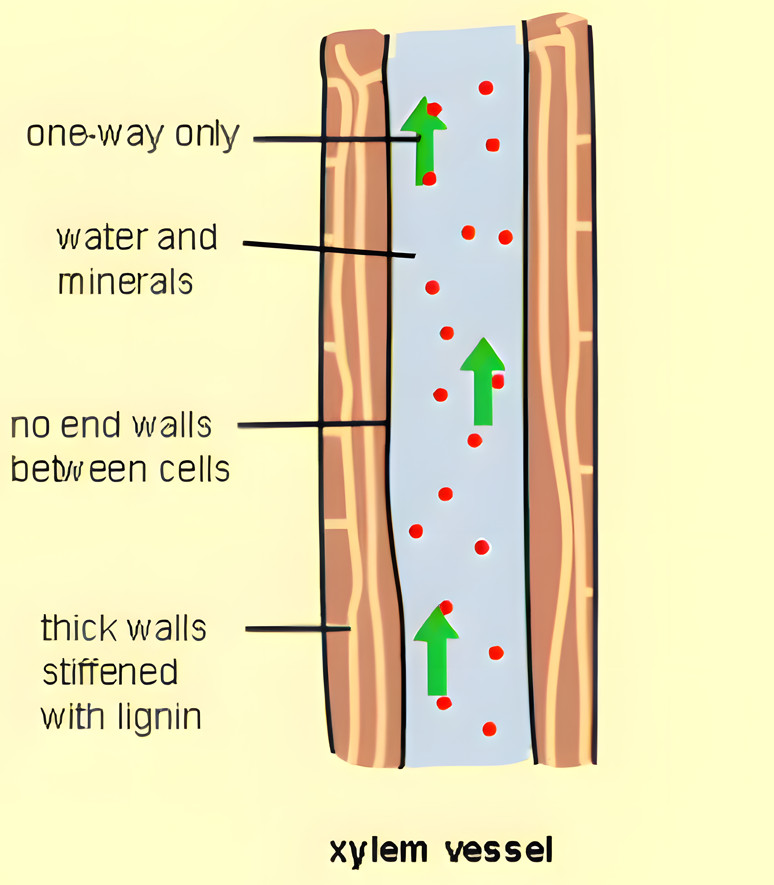
Xylem vessels are the tubes that carry water and dissolved minerals up through the plant. Their structure is well suited to this job.
| Feature | How it helps |
|---|---|
| Thick walls | The walls are strengthened and rigid. They can withstand the tension (pulling force) created by the transpiration pull without collapsing. The thick walls also provide structural support to the plant. |
| No cell contents (hollow) | The inside of the tube is empty — there are no organelles, cytoplasm, or nucleus. This means nothing blocks the flow of water, allowing it to move freely and quickly through the tube. |
| Cells joined end-to-end with no cross walls | Individual xylem cells are connected end-to-end with the walls between them broken down. This forms one long, unbroken tube from root to leaf, so water can flow continuously without any barriers. |
7. Translocation — Moving Sugars and Amino Acids in the Phloem #
What is transported? #
- Sucrose — the sugar made during photosynthesis in the leaves. It is the main form in which the plant moves energy around.
- Amino acids — the building blocks for proteins. They are transported to growing parts of the plant.
Direction of flow #
Unlike xylem (which only moves water upward), phloem can move substances in both directions:
- From leaves downward — sucrose made in the leaves moves down to the roots, where it can be used for energy or stored.
- From storage upward — stored sugars in the roots can be moved upward to growing shoots, flowers, or fruits that need energy.
8. Identifying Xylem, Phloem and Vascular Bundles in Cross-Sections #
In the IGCSE exam you may be asked to identify tissues in a transverse section (a slice across) of a non-woody dicotyledonous root or stem.
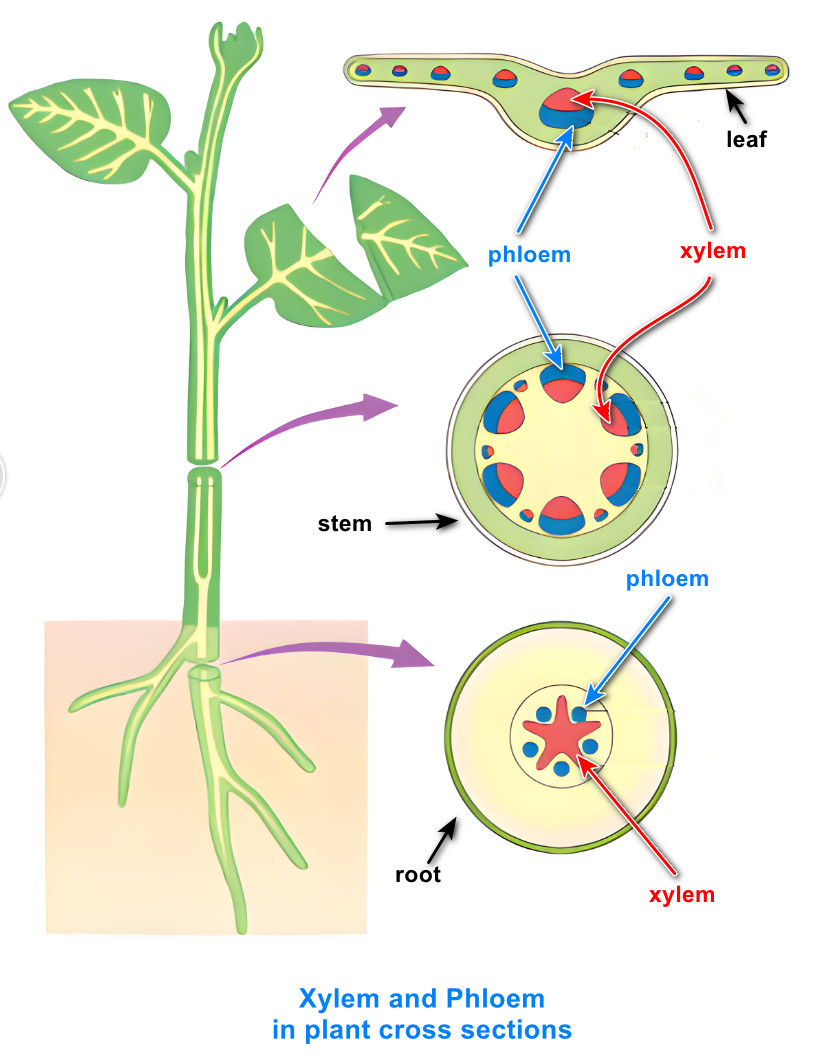
In the Stem #
Vascular bundles are arranged in a ring near the outside of the stem. Each bundle contains:
- Xylem — on the inner side of the bundle (towards the centre of the stem)
- Phloem — on the outer side of the bundle (towards the outside of the stem)
In the Root #
Vascular tissue is found in the centre of the root. The xylem forms a star shape in the middle, and the phloem is found in between the arms of the xylem star.
Functions of Xylem and Phloem #
| Tissue | Functions |
|---|---|
| Xylem |
|
| Phloem |
|
Syllabus Reference — 7.1 Uptake and Transport of Water and Ions #
- Relate the structure of root hair cells to their function of water and ion uptake
- Outline the pathway taken by water through the root, stem and leaf, limited to: root cortex cells, xylem and mesophyll cells
- Investigate, using a suitable stain, the pathway of water
Syllabus Reference — 7.2 Transpiration and Translocation #
- Define transpiration as the loss of water vapour from the surfaces of the mesophyll cells and then diffuses through air spaces and then through the stomata
- Understand that water evaporation from the surfaces of the mesophyll cells into air spaces and then diffuses
through the stomata. Explain:
- the effects of wind speed, humidity and light intensity on transpiration rate
- why wilting occurs
- Investigate the effects of wind speed, light intensity and temperature on transpiration rate
- Explain the mechanism by which water moves upwards in the xylem in terms of a transpiration pull that draws up a column of water molecules held together by cohesion
- Describe translocation as the movement of sucrose and amino acids in the phloem from parts of plants that produce or store them to parts that use or store them
- Identify the position of tissues as seen in transverse sections of non-woody dicotyledonous roots and stems (xylem, phloem and vascular bundles)
- State the functions of xylem as transport of water and minerals, and support
- Relate the structure of xylem vessels to their function, limited to:
- thick walls (details of lignification are not required)
- no cell contents
- cells joined end to end with no cross walls to form a long continuous tube


