
3.2.1 — Reflection of Light #
IGCSE Physics | Core & Supplement
When light hits a smooth surface — like a mirror — it bounces off in a predictable direction. This is called reflection. We can use simple rules to predict exactly where light will go after it reflects, and to understand how mirrors form images.
1. Key Terms #
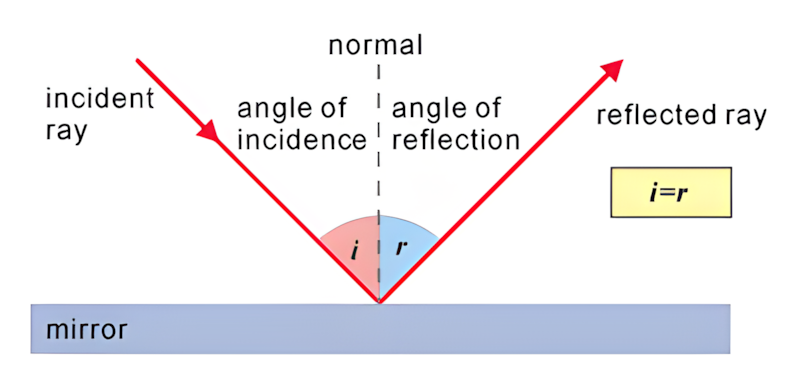
2. The Law of Reflection #
When light reflects off a surface, it follows one simple rule:
For example: if light hits a mirror at 30° from the normal, it reflects at exactly 30° on the other side of the normal.
A ray of light hits a plane mirror at an angle of incidence of 40°. What is the angle of reflection?
- Formula: $i = r$
- Given: $i = 40°$
- Therefore: $r = 40°$
Answer: The angle of reflection is 40°.
3. Image in a Plane Mirror #
When you look into a flat (plane) mirror, you see an image. This image has three key characteristics you must know:
IMAGE NEEDED: Diagram showing an object in front of a plane mirror with the image appearing behind the mirror — with equal distances marked
Google Images Search: “IGCSE physics plane mirror image formation diagram virtual image same distance educational”
| Characteristic | What it means |
|---|---|
| Same size | The image is exactly the same size as the object. It is not magnified or shrunk. |
| Same distance from mirror | The image appears as far behind the mirror as the object is in front of it. If the object is 5 cm from the mirror, the image appears 5 cm behind it. |
| Virtual | The image cannot be projected onto a screen. Light rays only appear to come from behind the mirror — they do not actually meet there. |
4. Constructions and Calculations Supplement #
4a. Drawing a Reflected Ray #
To draw the reflected ray from a plane mirror:
- Draw the normal — a dashed line at 90° to the mirror at the point where the ray hits.
- Measure the angle of incidence ($i$) between the incoming ray and the normal.
- Draw the reflected ray on the other side of the normal at the same angle: $r = i$.
4b. Locating the Image #
To find where the image of an object appears in a plane mirror:
- Draw two rays from the object to two different points on the mirror.
- Reflect each ray using the law of reflection ($i = r$).
- Extend the reflected rays behind the mirror using dashed lines.
- The image is where the two dashed lines meet behind the mirror.
IMAGE NEEDED: Ray diagram showing two reflected rays extended behind a plane mirror to locate the virtual image
Google Images Search: “IGCSE physics plane mirror ray diagram construction virtual image two rays behind mirror educational”
4c. Calculations #
An object is placed 8 cm in front of a plane mirror. How far behind the mirror does the image appear? How far is the object from its image?
- Image distance = object distance, so the image is 8 cm behind the mirror.
- Total distance from object to image = 8 + 8 = 16 cm.
A ray of light hits a plane mirror. The angle between the ray and the mirror surface is 35°. Find the angle of reflection.
- The angle given is from the mirror surface, not the normal.
- Angle of incidence = 90° − 35° = 55°
- By the law of reflection: $r = i =$ 55°
Answer: The angle of reflection is 55°.
Syllabus Reference — 3.2.1 Reflection of Light #
Core
- Define and use the terms normal, angle of incidence and angle of reflection
- Describe the formation of an optical image by a plane mirror and give its characteristics, i.e. same size, same distance from mirror, virtual
- State that for reflection, the angle of incidence is equal to the angle of reflection; recall and use this relationship
Supplement
- Use simple constructions, measurements and calculations for reflection by plane mirrors


