
IGCSE Biology | Respiration
All living cells need energy to work. They get this energy by breaking down glucose in a process called respiration. Respiration happens inside every cell, all the time. There are two types: aerobic respiration (uses oxygen) and anaerobic respiration (no oxygen needed).
1. What is Respiration? #
Respiration is not the same as breathing. Breathing moves air in and out of your lungs. Respiration is a chemical process that happens inside cells. Every living cell — whether in a plant, animal, or microorganism — carries out respiration.
2. How Living Organisms Use Energy #
The energy released by respiration is used for many processes in the body:
| Use of Energy | What it means |
|---|---|
| Muscle contraction | Muscles need energy to contract and move the body. |
| Protein synthesis | Cells use energy to join amino acids together to make proteins. |
| Cell division | Cells need energy to divide and produce new cells for growth and repair. |
| Active transport | Moving substances across cell membranes against the concentration gradient requires energy. |
| Growth | Building new cells and tissues for the organism to grow. |
| Nerve impulses | Electrical signals travel along neurones to carry information around the body. |
| Maintaining body temperature | Warm-blooded animals (like humans) use energy to keep their body temperature constant. |
3. Effect of Temperature on Respiration in Yeast #
Yeast is a microorganism that carries out anaerobic respiration, producing carbon dioxide gas. We can measure the rate of respiration in yeast by counting how fast CO&sub2; bubbles are produced.
Setup:
- Mix yeast with glucose solution in a flask.
- Connect the flask to a delivery tube placed in limewater (or count bubbles directly).
- Place the flask in a water bath at a set temperature.
- Count the number of CO&sub2; bubbles produced per minute.
- Repeat at different temperatures (e.g. 10°C, 20°C, 30°C, 40°C, 50°C).
- Keep the amount of yeast and glucose the same each time.
Results:
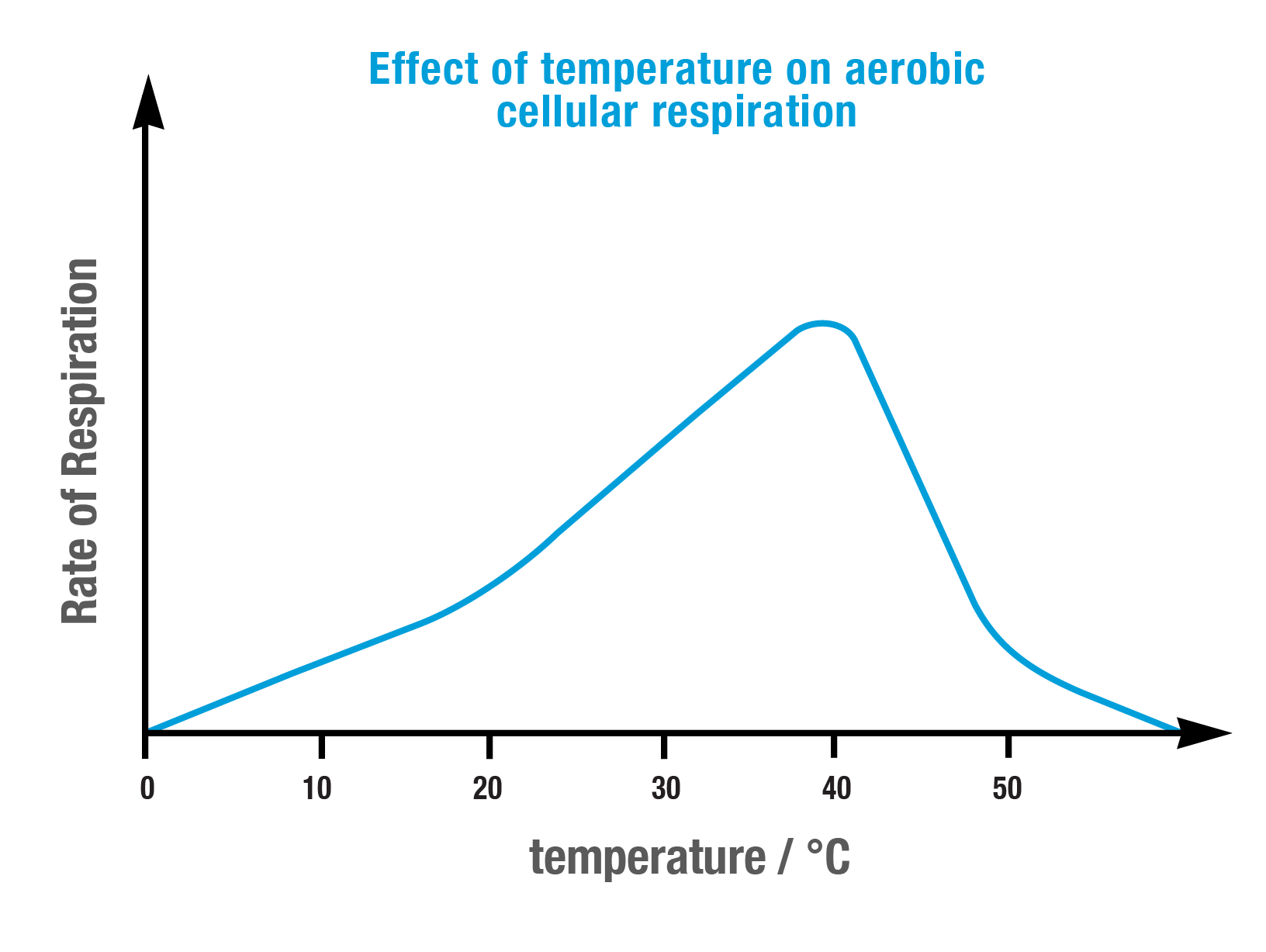
- As temperature increases, the rate of respiration increases — the yeast respires faster.
- At very high temperatures (above ~45–50°C), the rate drops sharply because the yeast’s enzymes are denatured (broken down by heat).
Conclusion: There is an optimum temperature for yeast respiration. Too cold = slow enzymes. Too hot = denatured enzymes.
4. Aerobic Respiration (10.2) #
Aerobic respiration happens when there is enough oxygen available. It releases a lot of energy and is the main type of respiration used by most organisms most of the time.
Word Equation #
glucose + oxygen → carbon dioxide + water (+ energy released)
Balanced Chemical Equation #
5. Anaerobic Respiration (10.3) #
When cells cannot get enough oxygen — for example, during intense exercise — they switch to anaerobic respiration. It is much less efficient than aerobic respiration, releasing far less energy from the same amount of glucose.
In Humans (Muscles) #
During hard exercise, muscles may not get enough oxygen. They respire anaerobically and produce lactic acid.
glucose → lactic acid (+ small amount of energy)
In Yeast (and other microorganisms) #
Yeast respires anaerobically and produces ethanol (alcohol) and carbon dioxide. This process is called fermentation.
glucose → ethanol + carbon dioxide (+ small amount of energy)
Aerobic Respiration #
- Needs oxygen
- Releases a large amount of energy
- Products: CO&sub2; + water
- Happens all the time in most cells
Anaerobic Respiration #
- No oxygen needed
- Releases a small amount of energy
- Products: lactic acid (humans) or ethanol + CO&sub2; (yeast)
- Happens when oxygen supply is too low
6. Lactic Acid Build-Up and Oxygen Debt (EPOC) #
Why Lactic Acid Builds Up #
During vigorous exercise, your muscles need energy faster than aerobic respiration can supply it. They switch to anaerobic respiration, which produces lactic acid. Lactic acid builds up in the muscles and passes into the blood. This causes the muscle pain and fatigue you feel during intense exercise.
How the Oxygen Debt is Removed #
After exercise stops, the body continues to work harder than normal to remove the lactic acid. This happens in two ways:
The heart keeps beating faster after exercise. This speeds up blood flow, transporting lactic acid from the muscles to the liver.
Breathing stays fast and deep after exercise. This supplies extra oxygen to the liver, where the oxygen is used to break down the lactic acid.
Syllabus Reference — Cambridge O Level Biology 5090 #
10.1 Respiration #
- Describe respiration as the chemical reactions in all living cells that release energy from glucose
- State the uses of energy in living organisms including muscle contraction, protein synthesis, cell division, active transport, growth, the passage of electrical impulses along neurones and the maintenance of a constant body temperature
- Investigate and describe the effect of temperature on respiration in yeast
10.2 Aerobic respiration #
- Describe aerobic respiration as the release of a relatively large amount of energy by the breakdown of glucose in the presence of oxygen
- State the word equation and balanced chemical equation for aerobic respiration
10.3 Anaerobic respiration #
- Describe anaerobic respiration as the release of a relatively small amount of energy by the breakdown of glucose without using oxygen
- State the word equation for anaerobic respiration in humans
- State the word equation for anaerobic respiration in yeast
- Explain why lactic acid builds up in muscles and blood during vigorous exercise causing Excess Post-exercise Oxygen Consumption (EPOC) or an ‘oxygen debt’
- Outline how the oxygen debt is removed after exercise, limited to:
- continuation of fast heart rate to transport lactic acid in blood from muscles to the liver
- continuation of deeper and faster breathing to supply oxygen for the breakdown of lactic acid in the liver


