
Table of Contents
IGCSE Physics | Core & Supplement
1. Mass #
Definition
Mass is the amount of matter in an object. It is measured relative to the observer when the object is at rest.
- The unit of mass is the kilogram (kg).
- Mass does not change depending on where the object is — it stays the same on Earth, on the Moon, or anywhere in space.
2. Weight #
Definition
Weight is the gravitational force acting on an object that has mass. It is a force, so it is measured in newtons (N).
Mass vs Weight: Mass is the amount of matter in an object and never changes. Weight is a force caused by gravity — it changes depending on where you are. An astronaut has the same mass on the Moon as on Earth, but their weight is much less because the Moon’s gravity is weaker.
3. Gravitational Field Strength #
Definition
Gravitational field strength ($g$) is the gravitational force acting per unit mass. It tells you how strong gravity is in a particular place.
The equation is:
$$g = \frac{W}{m}$$- $g$ = gravitational field strength (N/kg)
- $W$ = weight (N)
- $m$ = mass (kg)
This can be rearranged to find weight:
$$W = m \times g$$
On Earth: $g \approx 10\ \text{N/kg}$
This means every 1 kg of mass has a weight of about 10 N on Earth.
This means every 1 kg of mass has a weight of about 10 N on Earth.
Worked Example — A rock has a mass of 5 kg. Calculate its weight on Earth. ($g = 10\ \text{N/kg}$)
- Formula: $$W = m \times g$$
- Given: $m = 5\ \text{kg}$, $g = 10\ \text{N/kg}$
- Substitute: $$W = 5 \times 10$$
- Answer: $$W = 50\ \text{N}$$
Gravitational Field Strength and Free Fall #
The value of $g$ is also equal to the acceleration of free fall. On Earth:
$$g \approx 10\ \text{m/s}^2$$This means a falling object (with no air resistance) speeds up by 10 m/s every second.
Same value, different units: $g = 10\ \text{N/kg}$ (as gravitational field strength) and $g = 10\ \text{m/s}^2$ (as acceleration of free fall) are the same quantity — just described in different ways.
4. Comparing Mass and Weight Using a Balance #
A balance can be used to compare the masses (or weights) of two objects.
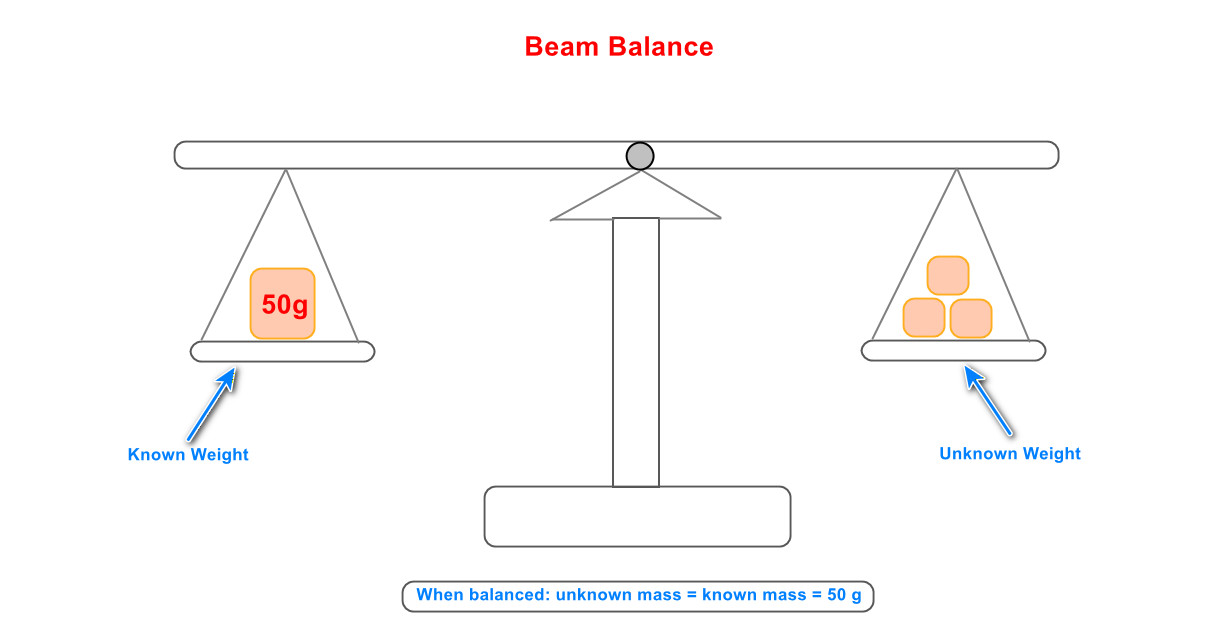
- A beam balance compares the mass of an unknown object against known masses. When the two sides are level, the masses are equal.
- Because both sides experience the same gravitational field strength, a beam balance gives the correct mass anywhere — even on the Moon.
5. Weight as the Effect of a Gravitational Field Supplement #
A gravitational field is a region of space where a mass experiences a force. Any object with mass creates a gravitational field around it.
When an object is placed inside a gravitational field, it experiences a pull toward the source of gravity. This pull is what we call weight.
Key Idea
Weight is the force that a gravitational field exerts on a mass. The stronger the gravitational field, the greater the weight of the same object.
Different planets have different gravitational field strengths, so the same object has a different weight on each planet:
| Location | Gravitational Field Strength ($g$) | Weight of a 10 kg object |
|---|---|---|
| Earth | 10 N/kg | 100 N |
| Moon | 1.6 N/kg | 16 N |
| Mars | 3.7 N/kg | 37 N |
Remember: Mass stays the same everywhere. Weight changes because the strength of the gravitational field changes.


