
IGCSE Mathematics | Core Topic
When a measurement is rounded, the exact true value is unknown. It could be slightly less or slightly more than the number given. Limits of accuracy tell you the range of values the true measurement could be. The two limits are called the lower bound and the upper bound.
1. Upper and Lower Bounds #
- Lower bound — the smallest value that would round to the given number
- Upper bound — the smallest value that would round to the next number up (any value at or above this would no longer round to the given number)
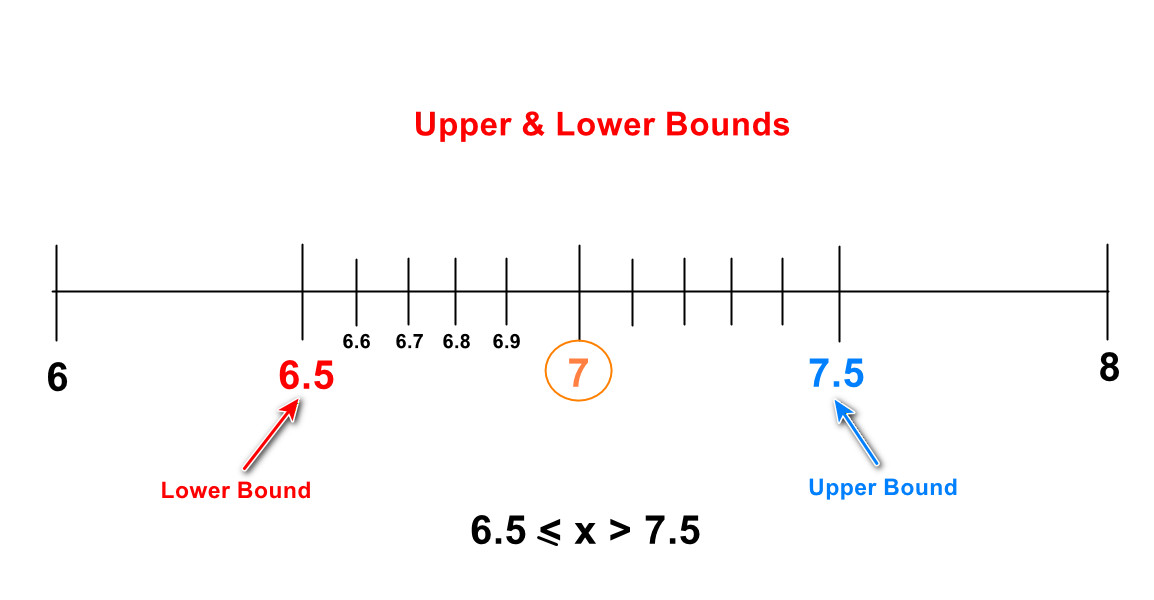
The true value $x$ satisfies: $\text{lower bound} \leq x < \text{upper bound}$
2. How to Find the Bounds #
Find the degree of accuracy (the unit being rounded to), then divide it by 2.
$$\text{Lower bound} = \text{given value} – \frac{\text{degree of accuracy}}{2}$$ $$\text{Upper bound} = \text{given value} + \frac{\text{degree of accuracy}}{2}$$A length is measured as $7\text{ m}$, correct to the nearest metre. Find the upper and lower bounds.
- Degree of accuracy = $1\text{ m}$ → $1 \div 2 = 0.5\text{ m}$
- Lower bound $= 7 – 0.5 = 6.5\text{ m}$
- Upper bound $= 7 + 0.5 = 7.5\text{ m}$
- The true length $x$ satisfies: $6.5\text{ m} \leq x < 7.5\text{ m}$
A road is measured as $340\text{ m}$, correct to the nearest 10 metres. Find the upper and lower bounds.
- Degree of accuracy = $10\text{ m}$ → $10 \div 2 = 5\text{ m}$
- Lower bound $= 340 – 5 = 335\text{ m}$
- Upper bound $= 340 + 5 = 345\text{ m}$
- The true length $x$ satisfies: $335\text{ m} \leq x < 345\text{ m}$
A mass is recorded as $4.6\text{ kg}$, correct to 1 decimal place. Find the upper and lower bounds.
- 1 decimal place means the nearest $0.1$, so degree of accuracy $= 0.1\text{ kg}$ → $0.1 \div 2 = 0.05\text{ kg}$
- Lower bound $= 4.6 – 0.05 = 4.55\text{ kg}$
- Upper bound $= 4.6 + 0.05 = 4.65\text{ kg}$
- The true mass $m$ satisfies: $4.55\text{ kg} \leq m < 4.65\text{ kg}$
A number is given as $8.45$, correct to 2 decimal places. Find the upper and lower bounds.
- 2 decimal places means the nearest $0.01$, so degree of accuracy $= 0.01$ → $0.01 \div 2 = 0.005$
- Lower bound $= 8.45 – 0.005 = 8.445$
- Upper bound $= 8.45 + 0.005 = 8.455$
- The true value $x$ satisfies: $8.445 \leq x < 8.455$
3. Quick Reference Table #
| Rounded to | Degree of accuracy | Add / subtract |
|---|---|---|
| Nearest 100 | 100 | 50 |
| Nearest 10 | 10 | 5 |
| Nearest whole number (1) | 1 | 0.5 |
| 1 decimal place (0.1) | 0.1 | 0.05 |
| 2 decimal places (0.01) | 0.01 | 0.005 |
Syllabus Reference — C1.10 Limits of Accuracy #
Give upper and lower bounds for data rounded to a specified accuracy.
Note: Candidates are not expected to find the bounds of the results of calculations which have used data rounded to a specified accuracy.


