
Christians worship God in many ways, but one of the most important is gathering together in a church. The word “church” can mean the building where Christians meet, but it also means the community of Christian people themselves. Understanding both meanings — and the key features found inside church buildings — is essential for this topic.
C1.1 — Worship in the Church #
The Church Building #
For Christians, the church building is a special and important place. It is where the community gathers regularly to worship God together. Sunday services are the main form of communal worship, but the building is also used for important events such as baptisms, weddings, funerals, and festivals like Christmas and Easter.
Beyond worship, the church building often acts as the centre of the local community. Many churches run activities and services that help local people — for example, supporting those in need or providing a space for the community to meet. In this way, the building is not only a place of worship but also a place where Christians live out their faith in practical ways.
The Church as People, Not Just a Building #
In Christianity, “church” has a second, deeper meaning. It does not only refer to the physical building — it also refers to the community of Christian believers themselves. Christians believe that wherever they gather in the name of God, that gathering is the church.
This means that the church is alive through its members. The people worship, support each other, serve the community, and carry out their faith in daily life.
The whole community of Christian believers, not just the physical building where they meet.
C1.2 — Key Features of Church Buildings #
Different Christian traditions build and decorate their churches differently, but many share common features. Each feature has a meaning and purpose that reflects what that community believes about worship and faith.
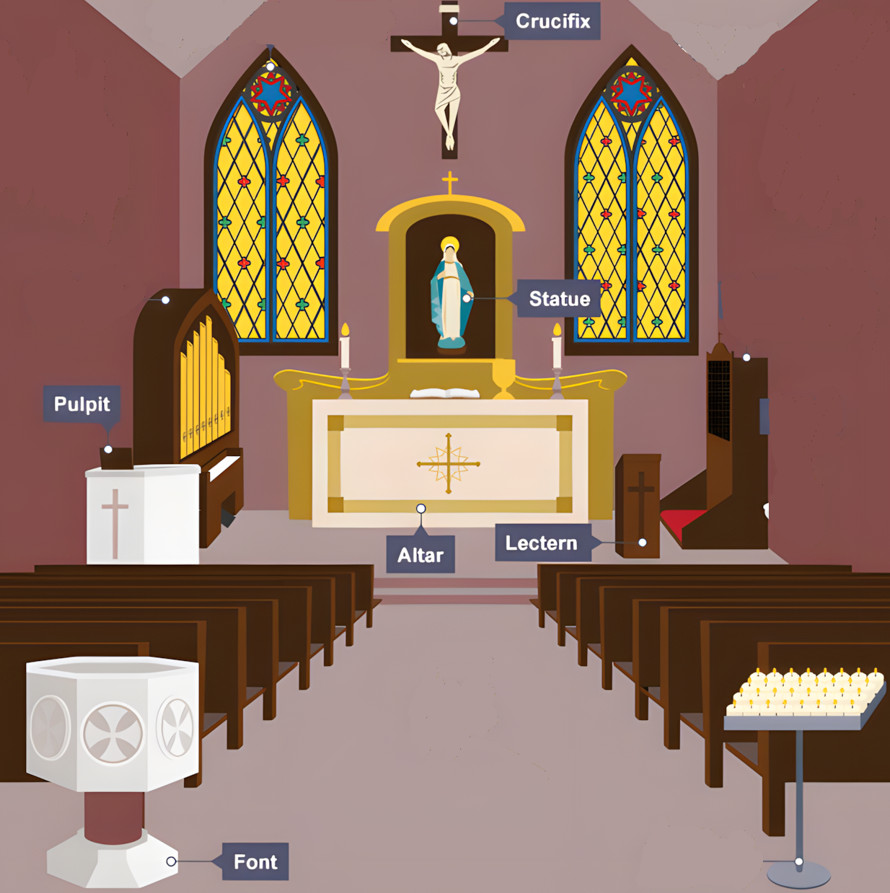
The altar (also called the holy table) is a raised table found at the front of the church. It is one of the most important features in many Christian traditions.
It is used during Holy Communion — the service where Christians remember the Last Supper of Jesus, when he shared bread and wine with his disciples.
Importance: The altar is a symbol of the sacrifice of Jesus and of God’s presence. For many Christians, it is the central point of the whole church and of worship.
In some traditions it is called the “altar” and is treated as very sacred; in others it is called the “holy table” and has a simpler appearance, showing that it is a table for sharing a meal rather than a place of sacrifice.
The sanctuary is the holy area of the church. It is usually the area at the front of the building, near the altar, and is often set apart from the main seating area by steps or a low rail.
The word “sanctuary” also carries the meaning of a safe and sacred place — somewhere set apart for God.
Importance: The sanctuary represents the holiness of God and reminds worshippers that they are entering a sacred space in his presence.
The lectern is a reading stand, usually placed to one side at the front of the church. It holds the Bible during services, and a reader stands at it to read passages of Scripture aloud to the congregation.
Importance: The lectern represents the importance of the Bible in Christian worship. By giving the Bible its own stand, the church shows that God’s word deserves respect and a place of honour.
The pulpit is a raised platform at the front of the church from which the minister or preacher addresses the congregation. It is raised so that the speaker can be clearly seen and heard by everyone in the building.
The preacher uses the pulpit to deliver the sermon — a talk based on a Bible passage that teaches and guides the congregation.
Importance: The pulpit represents the central role of preaching and the Bible in Christian worship. In many Protestant and non-conformist churches, the pulpit is the most prominent feature in the building, showing that the sermon is the heart of worship.
These two features are both connected to the sacrament of baptism — the ritual use of water to welcome a person into the Christian faith — but they are used in different ways by different denominations.
Baptistery: A pool large enough for a person to be fully submerged in water (total immersion). It is used by denominations that baptise adults who have personally chosen to follow Christ. The person is lowered into the water and raised back up, symbolising dying to the old life and rising to a new life in Christ.
Font: A container of water, usually a stone bowl on a stand. It is used for baptism by sprinkling or pouring a small amount of water on the person’s head. Fonts are commonly used for infant baptism. The font is often placed near the entrance of the church, symbolising baptism as the entry point into the Christian community.
Importance: Both the baptistery and font represent baptism as an important act of faith and of joining the church.
IMAGE NEEDED: Side-by-side comparison of a baptistery (immersion pool) and a baptismal font
Google Images Search: “IGCSE Religious Studies baptistery immersion pool vs baptismal font comparison educational”
Many church buildings contain statues, images and decorations. These are used to help worshippers focus on their faith and to create a sense of the sacred.
Statues: Three-dimensional figures, often representing Jesus or other figures from the Christian faith. They are common in many traditions and are used as a focus for prayer and reflection.
Images: Paintings, mosaics, or pictures depicting scenes or figures from the Christian faith. They help tell the stories of the faith visually and can deepen a worshipper’s understanding and devotion.
Decorations: Items used to make the church environment feel holy and set apart for worship. These create an atmosphere that helps worshippers feel they are in a sacred place.
Importance: For those who use them, statues, images and decorations are aids to worship that help the believer feel closer to God and the figures of their faith.
C1.2(g) — Differing Views on the Importance of These Features #
Different Christian denominations and traditions do not all agree on how important these features are. Some place great importance on the physical features of the church building; others believe that outward features matter very little compared to inner faith and the word of God.
| Feature | Traditions that emphasise it | Traditions that place less emphasis on it |
|---|---|---|
| Altar / Holy Table | Catholic and Anglican traditions: the altar is the central focus of the church; Holy Communion is the most important act of worship. | Many non-conformist traditions (e.g. Baptist, Methodist): the holy table is simpler and less prominent; preaching takes priority over the Eucharist. |
| Sanctuary | Catholic, Anglican and Orthodox traditions: the sanctuary is a clearly defined, very sacred area, often separated from the rest of the church. | Many evangelical and non-conformist traditions: less distinction is made between the sanctuary and the rest of the building; the whole space is treated as sacred. |
| Lectern | Used across most traditions as a place to read Scripture. | Some traditions use a simple stand without a formal lectern; the focus is on the words read, not the object itself. |
| Pulpit | Protestant and non-conformist traditions: the pulpit is often the most prominent feature in the church, reflecting the belief that preaching and the Bible are central to worship. | Catholic tradition: the altar takes priority; the pulpit is present but less dominant. |
| Baptistery | Baptist and other traditions that practise believer’s baptism by total immersion: the baptistery is an essential feature of the church building. | Traditions that practise infant baptism (e.g. Catholic, Anglican, Methodist) use a font rather than a baptistery. |
| Font | Catholic, Anglican and Methodist traditions: the font is important and is often placed at the entrance to symbolise entry into the faith. | Traditions that use the baptistery for adult immersion do not use a font. |
| Statues, Images & Decorations | Catholic and Orthodox traditions: statues, images and decorations are very important as aids to worship. They help focus prayer and devotion. | Many Protestant traditions (e.g. Baptist): few or no statues and images are used. Some believe they distract from true worship of God or can become a form of idol worship. Their buildings tend to be plain. |


