
- 6.3.1 — Types of Migrant
- 6.3.2 — Causes of Migration: Push and Pull Factors
- 6.3.3 — The Impacts of Migration
- 6.3.4 — Strategies to Manage International Migration
- 6.3.5 — Case Study: International Migration from Mexico to the United States
- Syllabus Reference — Section 6.3: The Causes and Impacts of International Migration
Every year, millions of people leave their home countries to start a new life somewhere else. Some move for better jobs. Others are fleeing war or persecution. This movement of people between countries — called international migration — has major effects on the people who move, the countries they leave, and the countries they move to. Understanding why people migrate, and what happens as a result, is the focus of this topic.
6.3.1 — Types of Migrant #
Not everyone who moves to another country does so for the same reason. The syllabus requires you to know three specific types of migrant:
A person who moves to another country voluntarily, mainly to find work or earn a higher income. They are not fleeing danger — they choose to move to improve their standard of living. Example: a worker who leaves Mexico to take up a job in the United States.
A person who has fled their home country and applied for official protection in another country. Their application is still being reviewed — they are waiting for a decision. They are not yet recognised as refugees.
A person who has been officially recognised by another country as needing protection because they were forced to flee war, violence, or persecution. Unlike an asylum seeker, a refugee’s status has been confirmed and they are legally protected.
6.3.2 — Causes of Migration: Push and Pull Factors #
People do not migrate randomly. They are driven by reasons that can be grouped into two categories: push factors and pull factors.
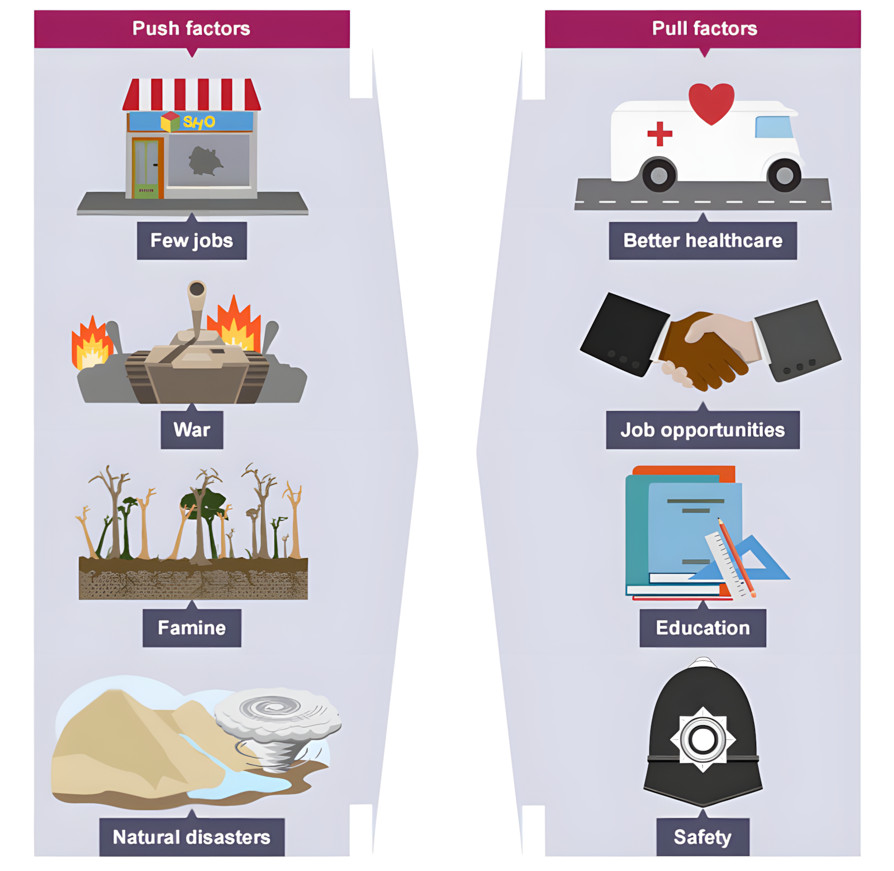
| Push Factors — Reasons to Leave | Pull Factors — Reasons to Move To a New Country |
|---|---|
| War, conflict, or persecution — violence makes life dangerous and unsafe | Better job opportunities and higher wages |
| Unemployment or poverty — no jobs or very low income | Safety, peace, and political stability |
| Natural disasters (floods, droughts, earthquakes) — destroy homes and farmland | Better healthcare and education systems |
| Poor access to healthcare and education | Family reunification — joining relatives who have already moved |
| Political instability or government oppression | Higher overall quality of life (better housing, freedom, and services) |
6.3.3 — The Impacts of Migration #
Migration has significant effects on three groups: the migrants themselves, the country they leave (the country of origin), and the country they move to (the destination country).
Impacts on the Migrant #
- Access to better-paid work and improved living standards
- Greater personal safety and freedom
- Better healthcare and education for themselves and their children
- Dangerous journey, especially for forced migrants crossing unsafe routes
- Language barriers and difficulty adjusting to a new culture
- Discrimination or racism in the destination country
- Separation from family left behind
- Uncertain legal status (particularly for asylum seekers)
Impacts on the Country of Origin #
- Remittances: migrants send money home to their families, which boosts household incomes and the local economy
- Reduced pressure on jobs and resources in areas that were overcrowded or had high unemployment
- Brain drain: skilled and educated workers (such as doctors, engineers, and teachers) leave, weakening the country’s workforce and slowing development
- An ageing population is left behind as young people are the most likely to migrate
- Family separation causes emotional and social problems in communities
Impacts on the Destination Country #
- Migrants fill labour shortages — taking on jobs in agriculture, construction, and healthcare that are difficult to fill
- Migrants pay taxes and spend money, contributing to economic growth
- Cultural diversity: new languages, traditions, food, and ideas enrich society
- Increased demand puts pressure on housing, schools, and healthcare
- Social tension can develop when language and cultural differences are not managed well
- Integration can be slow and difficult without proper government support
6.3.4 — Strategies to Manage International Migration #
Governments use a range of strategies and techniques to manage international migration. These vary from strict short-term controls to longer-term approaches that try to reduce the need to migrate in the first place.
Governments build fences, walls, and checkpoints and deploy border patrols to control who enters the country.
Effective at reducing illegal border crossings in the short term. However, it is very expensive, can be criticised as inhumane, and does not address the root causes of migration. Determined migrants often find other routes.
Migrants must apply for official permission to enter and work. Some countries select migrants based on their skills, qualifications, and job offers, giving priority to those the destination country needs most.
Helps attract skilled workers and keeps immigration organised and controlled. However, it can prevent desperate people (such as refugees) from accessing protection quickly, and may limit family reunification.
International organisations set up camps near conflict zones to provide temporary shelter, food, and medical care for displaced people. Countries also operate legal asylum processes for those seeking protection.
Provides immediate help to people in crisis. However, camps can become overcrowded and underfunded over time, and they are not a long-term solution. Asylum processes can be slow and uncertain for those waiting.
Destination countries offer language classes, job training, cultural orientation, and housing support to help migrants settle and contribute to society.
Reduces social tension and helps migrants become productive members of society. However, it is expensive and takes many years to show results.
Wealthier countries invest in education, jobs, and infrastructure in countries that send large numbers of migrants, aiming to reduce the push factors that drive people to leave in the first place.
This is considered the most sustainable strategy because it tackles the root causes of migration rather than simply trying to stop people at the border. However, results are very slow — development takes decades — and aid must be well managed to be effective.
6.3.5 — Case Study: International Migration from Mexico to the United States #
The movement of people from Mexico to the United States is one of the largest and most studied examples of international migration in the world. It is shaped by a powerful mix of push factors in Mexico and pull factors in the USA.
Push and Pull Factors #
| Push Factors — Mexico (Origin) | Pull Factors — USA (Destination) |
|---|---|
| High poverty levels, especially in rural areas where wages are very low | Strong demand for workers in agriculture, construction, and service industries |
| High unemployment, particularly for unskilled workers | Significantly higher wages than in Mexico — even for unskilled labour |
| High crime rates and gang violence in some regions, making daily life unsafe | Greater personal safety and political stability |
| Limited access to quality healthcare and education in rural areas | Better healthcare and education systems |
| Droughts and natural disasters affecting agriculture and food supply | Family reunification — a large, established Mexican-American community makes settling easier |
Impacts of the Migration #
- Higher income and improved standard of living
- Access to better healthcare and education for their children
- Greater personal safety
- Dangerous border crossing — migrants risk extreme heat, dehydration, and exploitation
- Language barriers and cultural adjustment
- Discrimination and social exclusion
- Uncertain legal status for undocumented migrants, with risk of deportation
- Separation from family left behind in Mexico
- Remittances: Mexico receives over \$50 billion per year from migrants abroad — one of the highest amounts in the world. This money helps families pay for housing, healthcare, and education
- Reduced pressure on the job market in high-unemployment areas
- Brain drain: Mexico loses skilled workers (doctors, engineers, teachers), weakening its economy long-term
- Rural communities are left with ageing populations as young people leave
- Family separation causes long-term emotional and social problems
- Mexican migrants fill vital shortages in agriculture, food processing, construction, and hospitality
- Migrants pay taxes and spend money, contributing to economic growth
- Mexican culture has enriched American food, music, and communities
- Pressure on housing, schools, and healthcare in border states such as Texas and California
- Ongoing political controversy around undocumented immigration and border security
- Social integration challenges, including language barriers and occasional community tensions
How the Migration is Managed #
Both the USA and Mexico use a range of strategies to manage this migration:
| Strategy | Description |
|---|---|
| US-Mexico border wall and patrols | Physical barriers and increased border patrol agents are used to control illegal crossings |
| Deportation of undocumented migrants | People found to be living in the USA without authorisation can be returned to Mexico |
| H-2A temporary work visa | A legal programme that allows Mexican agricultural workers to enter the USA on temporary work permits — a controlled and legal pathway for seasonal labour |
| Asylum process | Migrants can apply for refugee status or asylum at official entry points. Those who qualify are allowed to stay legally |
| US development investment in Mexico (sustainable) | The US government has invested in programmes to reduce poverty, improve security, and create jobs in Mexico and Central America. By improving conditions at the source, the aim is to reduce the push factors that drive migration — this is the most sustainable approach as it targets the root causes |
Syllabus Reference — Section 6.3: The Causes and Impacts of International Migration #
| Point | Syllabus Statement |
|---|---|
| 6.3.1 | Types of migrant: economic migrant, asylum seeker and refugee. |
| 6.3.2 | Causes of migration, to include push and pull factors. |
| 6.3.3 | The impacts of migration on the migrant, their country of origin and the destination country. |
| 6.3.4 | An evaluation of the strategies and techniques used to manage international migration. |
| 6.3.5 | One detailed specific example to include:
|


