
Right now, over 8 billion people live on Earth. That number has not always been so large, and it is not growing at the same speed everywhere. In some parts of the world, populations are growing fast. In others, they are shrinking. Understanding why populations change — and how governments respond — is the focus of this topic.
6.1.1 — Patterns and Trends in Global Population Growth #
It took all of human history up to the year 1804 to reach 1 billion people. After that, the number grew much faster. In the 1960s, the world’s population was growing at its fastest ever rate — about 2.1% per year. Since then, the growth rate has slowed to less than 1% per year. Even so, because there are now so many people, the total number is still rising.
Where People Live #
People are not spread evenly across the world. Some regions are very densely populated, while others are almost empty. The most populated regions are East Asia, South Asia, Europe, and the eastern United States. These areas have good climates, farmable land, and economic opportunities. Harsh environments — such as deserts, the Arctic, and dense rainforests — have very few people.
IMAGE NEEDED: World map showing population distribution (densely vs sparsely populated regions)
Google Images Search: “IGCSE geography world population distribution map labeled educational”
6.1.2 — Reasons for Growth and Decline #
Five key factors determine whether a country’s population grows, stays the same, or declines. Each one is defined below.
The number of live births per 1,000 people in a country per year. A high birth rate means many babies are being born relative to the population size.
The number of deaths per 1,000 people in a country per year. A falling death rate means people are living longer or fewer people are dying young.
The average number of children a woman is expected to have during her lifetime. A fertility rate above 2.1 means the population will grow over time (replacing both parents plus a small extra). Below 2.1, the population will eventually shrink.
The difference between the birth rate and the death rate:
Natural Increase = Birth Rate − Death Rate
If the result is positive, the population grows. If it is negative, the population shrinks. This is the main
driver of population change.
The movement of people from one country to another. People moving into a country (immigration) increases its population. People moving out (emigration) decreases it. Migration can significantly change a country’s total population size.
How These Factors Differ Around the World #
| Factor | High-Income Countries | Low-Income Countries |
|---|---|---|
| Birth rate | Low | High |
| Death rate | Low | Falling (due to better healthcare) |
| Fertility rate | Below 2.1 in many countries | Often well above 2.1 |
| Natural increase | Low or even negative | High — population growing fast |
| Migration | Often a net gain (people moving in) | Often a net loss (people moving out) |
6.1.3 — Pro-Natalist and Anti-Natalist Policies #
Governments sometimes try to change the birth rate in their country by introducing population policies. There are two types:
- Pro-natalist policies — encourage people to have more children (to increase the birth rate).
- Anti-natalist policies — discourage people from having large families (to reduce the birth rate).
Problem: An ageing population with too few young people to support the economy.
What the government did:
- Generous monthly payments to families with children
- Up to 3 years of paid parental leave
- Heavily subsidised (low-cost) childcare
Impact on birth rate: France now has one of the highest fertility rates in Europe. The policy has had a moderate but positive effect on birth rates.
Problem: A very rapidly growing population that was straining food, water, and jobs.
What the government did:
- The One-Child Policy strictly limited most families to one child
- Fines and penalties for families who had more children
Impact on birth rate: The policy is credited with preventing an estimated 400 million births, helping reduce the birth rate significantly. However, it also created serious problems (see below).
Evaluating the Impacts #
| Pro-Natalist (France) | Anti-Natalist (China) | |
|---|---|---|
| Positive impacts | Raised fertility rate; slowed population ageing; helped sustain the workforce | Significantly reduced the birth rate; helped slow rapid population growth at a time when resources were under serious pressure |
| Negative impacts | Very expensive for the government; effect on birth rate was moderate, not dramatic | Human rights concerns; created a large gender imbalance (more males than females); led to a rapidly ageing population that China now struggles to support |
| Overall | Shows that policies can raise birth rates, but only to a moderate degree | Shows that strict policies can lower birth rates effectively, but always come with complex and sometimes severe unintended consequences |
6.1.4 — The Demographic Transition Model (DTM) #
The Demographic Transition Model (DTM) is a diagram that shows how a country’s birth rate and death rate typically change as the country develops over time. It divides this journey into five stages.
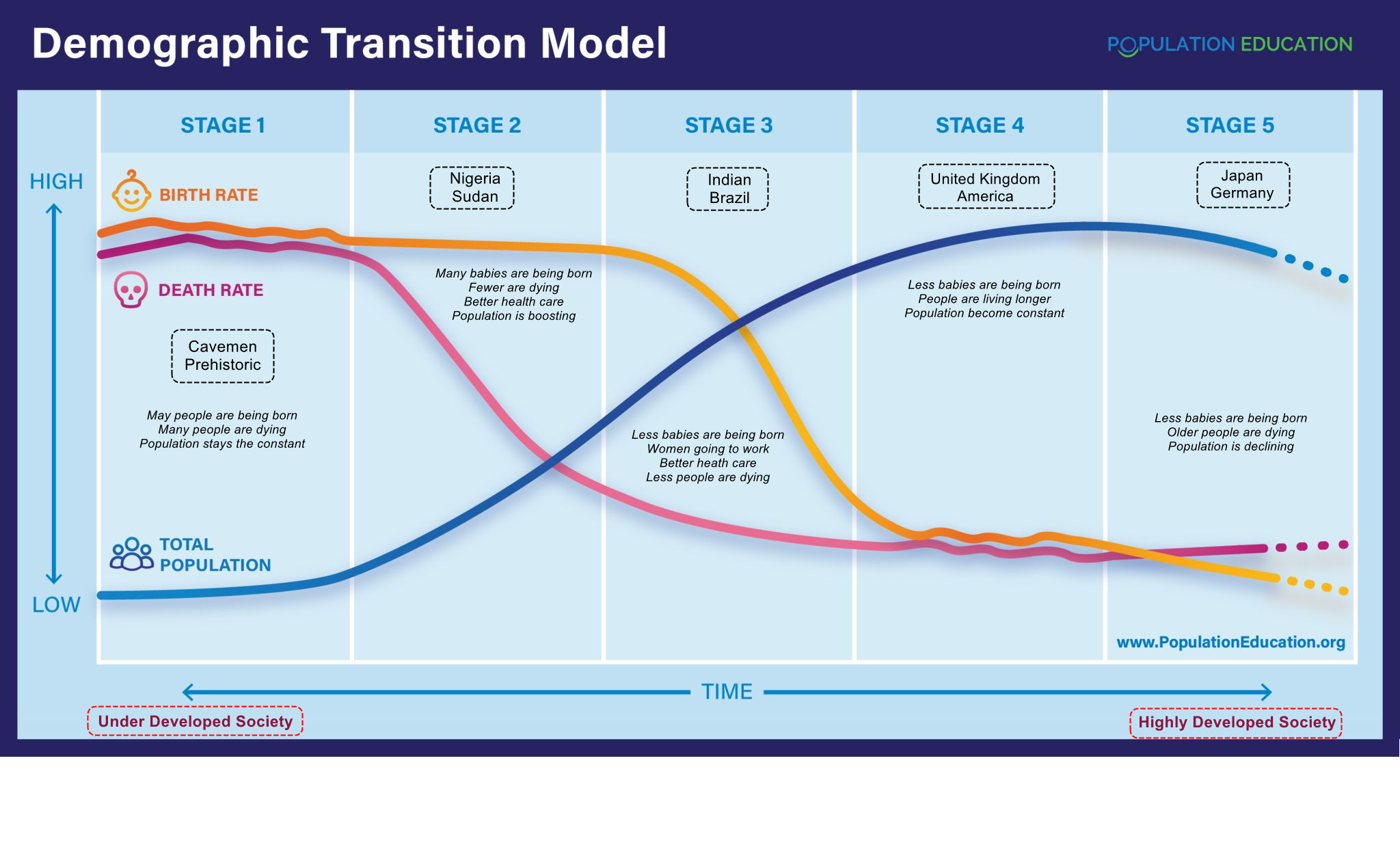
The Five Stages #
Strengths and Limitations of the DTM #
- Provides a clear, simple framework for understanding how populations change as a country develops.
- Based on real historical data from countries that have already gone through development (especially in Europe).
- Useful for comparing countries at different stages of development.
- Helps predict future population trends and plan government policies.
- Not every country follows the same path or moves through the stages at the same speed.
- Was originally developed based on European history, so it may not apply well to all countries.
- Does not include migration as a factor, even though migration can greatly affect population size.
- Government policies (like China’s One-Child Policy) can speed up or alter the typical pattern, which the model does not account for.
- Stage 5 was added later as an afterthought — the original model only showed four stages.
Syllabus Reference — Section 6.1: Populations Grow and Decline #
| Point | Syllabus Statement |
|---|---|
| 6.1.1 | Patterns and trends in global population growth. |
| 6.1.2 | Reasons for the growth and decline of a country’s population: fertility rate, birth rate, death rate, natural increase, migration. |
| 6.1.3 | An evaluation of the impacts of pro-natalist and anti-natalist policies on birth rates. |
| 6.1.4 | The demographic transition model (DTM) and its strengths and limitations. |


