
- 1. Positive and Negative Charges
- 2. How Charges Push and Pull (Attract and Repel)
- 3. Making Charge by Friction (Rubbing)
- 4. What Happens When We Rub: Electrons Move
- 5. Conductors and Insulators
- 6. Explaining Conductors and Insulators (Simple Electron Model)
- Supplement Topics
- 7. The Unit of Charge Supplement
- 8. The Electric Field Supplement
- 9. The Direction of an Electric Field Supplement
- 10. Electric Field Patterns Supplement
- Syllabus Reference — 4.2.1 Electric Charge
Everything around us is made of tiny particles, and some of these particles carry something called electric charge. Charge is what makes a balloon stick to a wall after you rub it on your hair, and it is the same thing that powers the electricity in our homes. In this topic you will learn that there are two kinds of charge, how charged objects push and pull on each other, and how objects become charged in the first place.
1. Positive and Negative Charges #
There are two types of electric charge:
- Positive charge (shown with a + sign)
- Negative charge (shown with a − sign)
2. How Charges Push and Pull (Attract and Repel) #
Charged objects can act on each other from a small distance. Whether they push apart or pull together depends on the type of charge each one has.
This gives us three situations:
- Two positive charges → repel (push apart)
- Two negative charges → repel (push apart)
- A positive and a negative charge → attract (pull together)
The bold black arrows below each pair show the direction of the force on each charge.
3. Making Charge by Friction (Rubbing) #
You can give an object an electric charge by rubbing it with another material. This is called charging by friction. The charge made by rubbing is sometimes called electrostatic charge (static means “not moving”).
Experiment 1 — Producing the charge #
- Take a plastic rod (for example a polythene rod) and a dry cloth or duster.
- Rub the rod with the cloth several times.
- The rubbing gives the rod an electric charge.
Experiment 2 — Detecting the charge #
To show that the rod is now charged, bring it close to small, light objects:
- Hold the charged rod near tiny pieces of paper — they jump up and stick to the rod.
- Or hold it near a thin stream of water from a tap — the water bends towards the rod.
If the rod can attract these light objects, it must be charged. This is how we detect electrostatic charge.
4. What Happens When We Rub: Electrons Move #
When two materials are rubbed together, only negative charge moves from one material to the other. This negative charge is carried by tiny particles called electrons.
Because electrons are negative, moving them changes the charge of both objects:
- The material that gains electrons ends up with extra negative charge → it becomes negatively charged.
- The material that loses electrons is left with fewer electrons than normal → it becomes positively charged.
Which material gains electrons and which loses them depends on the two materials being rubbed. Here are two common examples, both using a wool cloth:
5. Conductors and Insulators #
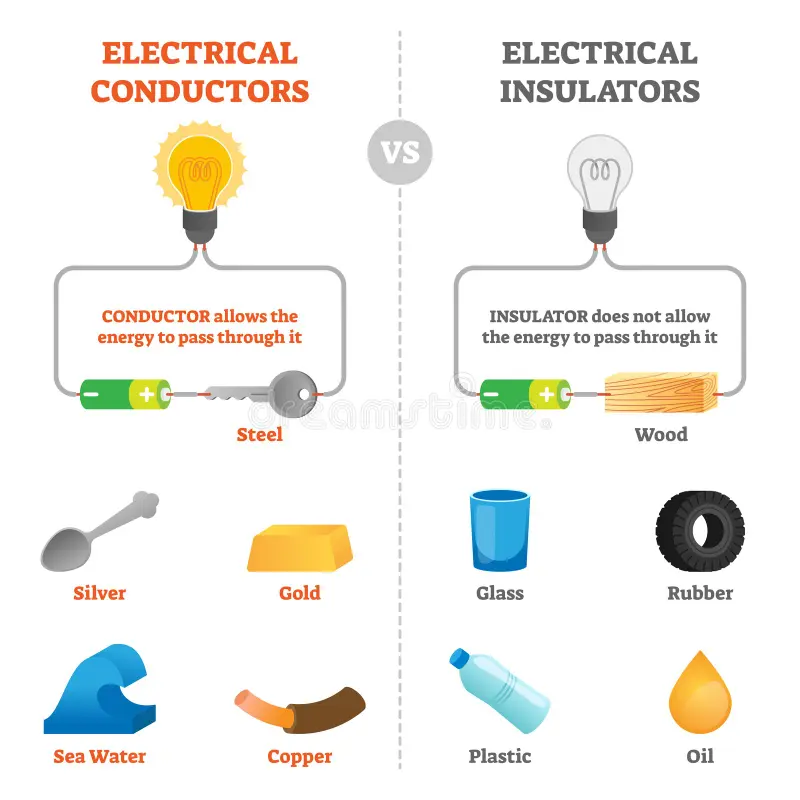
Some materials let electricity pass through them easily, and some do not.
Experiment — Testing if a material is a conductor or an insulator #
You can find out whether a material conducts electricity using a simple test circuit:
- Make a circuit with a battery (cell), a lamp, and connecting wires, leaving a gap in the circuit.
- Place the material you want to test across the gap.
- Watch the lamp:
- If the lamp lights up, charge can pass through → the material is a conductor.
- If the lamp stays off, charge cannot pass through → the material is an insulator.
- Repeat with different materials and record your results.
| Material tested | Lamp lights? | Conductor or insulator? |
|---|---|---|
| Copper wire / iron nail | Yes | Conductor |
| Plastic ruler | No | Insulator |
| Rubber band | No | Insulator |
| Aluminium foil | Yes | Conductor |
6. Explaining Conductors and Insulators (Simple Electron Model) #
We can explain the difference between conductors and insulators by thinking about the electrons inside the material.
| Conductors | Insulators | |
|---|---|---|
| Electrons | Have some electrons that are free to move through the material | Electrons are not free to move — they are held in place |
| Can charge flow? | Yes — the free electrons carry the charge through | No — there are no free electrons to carry charge |
| Typical examples | Copper, iron, aluminium and other metals | Plastic, rubber, glass, wood |
Supplement Topics #
The following sections are for Extended (Supplement) students only.
7. The Unit of Charge Supplement #
8. The Electric Field Supplement #
This means that if you place a charge anywhere inside an electric field, it will feel a push or a pull.
9. The Direction of an Electric Field Supplement #
10. Electric Field Patterns Supplement #
We draw electric fields using field lines (also called lines of force). The arrows on the lines show the direction of the field — that is, the direction of the force on a positive charge.
(a) Around a Point Charge #
The field lines are straight and spread out evenly, like the spokes of a wheel. They point away from a positive charge and towards a negative charge.
(b) Around a Charged Conducting Sphere #
The field around a charged conducting sphere looks just like the field around a point charge: the field lines are straight and spread out evenly, starting from the surface of the sphere. For a positive sphere they point outward.
(c) Between Two Oppositely Charged Parallel Plates #
Between two flat plates with opposite charges, the field lines are straight, parallel and evenly spaced. They point from the positive plate to the negative plate. This is called a uniform field because it has the same strength and direction everywhere between the plates.
Syllabus Reference — 4.2.1 Electric Charge #
Core
- State that there are positive and negative charges
- State that positive charges repel other positive charges, negative charges repel other negative charges, but positive and negative charges attract each other
- Describe simple experiments to show the production of electrostatic charges by friction and to show the detection of electrostatic charges
- Explain that charging of solids by friction involves only a transfer of negative charge (electrons)
- Describe an experiment to distinguish between electrical conductors and insulators
- Recall and use a simple electron model to explain the difference between electrical conductors and insulators and give typical examples
Supplement
- State that charge is measured in coulombs
- Describe an electric field as a region in which an electric charge experiences a force
- State that the direction of an electric field at a point is the direction of the force on a positive charge at that point
- Describe simple electric field patterns, including the direction of the field:
- (a) around a point charge
- (b) around a charged conducting sphere
- (c) between two oppositely charged parallel conducting plates (end effects will not be examined)


