
Information
- The total mark for this paper is 31.
- The number of marks for each question or part question is shown in brackets [ ].
- Answer all questions. Write your answers in the spaces provided.
Question 1 — Osmosis in Potato Sticks
Parts (a)–(d) • 10 marks total
Some students investigated osmosis in raw potato sticks.
(a)
Define the term osmosis. [3]
(b)
The students measured the mass of four of the potato sticks using an electronic balance. They left each
potato stick in one of four different liquids for 5 hours:
- distilled water
- 0.1 mol per dm3 sodium chloride solution
- 0.5 mol per dm3 sodium chloride solution
- 1.0 mol per dm3 sodium chloride solution
(i) Predict which of the liquids would cause the largest decrease in mass of a
potato stick. [1]
(ii) The students dried the potato sticks with paper towels before putting
them on the electronic balance. Suggest why. [1]
(c)
After the experiment the students noticed that the potato stick with the lowest mass was soft and
floppy.
Explain why the potato stick had become soft and floppy. [3]
Explain why the potato stick had become soft and floppy. [3]
(d)
The students followed the same experimental procedure with boiled potato sticks and found no overall change
in mass in any of the solutions.
Suggest why the mass of the boiled potato sticks remained the same. [2]
Suggest why the mass of the boiled potato sticks remained the same. [2]
Question 2 — Classification and Arthropods
Parts (a)–(c) • 11 marks total
(a)
Describe the meaning of the term species. [2]
(b)
Fig. 1.1 is a photograph of Lithobius forficatus, a species of myriapod.
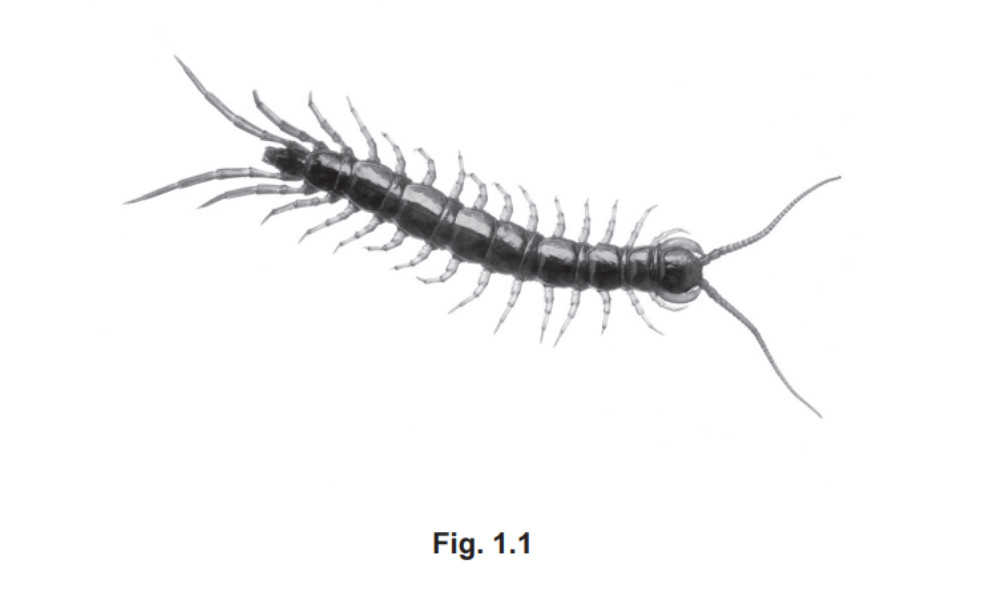
(i) State the genus of the organism shown in Fig. 1.1. [1]
(ii) State one feature visible in Fig. 1.1
that identifies the organism as: [2]
a myriapod
an arthropod
(iii) State the names of two groups of arthropods, other than
myriapods. [2]
1
2
(iv) State two features of plant cells that would be
absent in the cells of the organism shown in Fig. 1.1. [2]
1
2
(c)
Adaptive features enable organisms to survive in their environment. Fig. 1.2 is a photograph of another
species of arthropod. Some of its adaptive features are visible in Fig. 1.2.
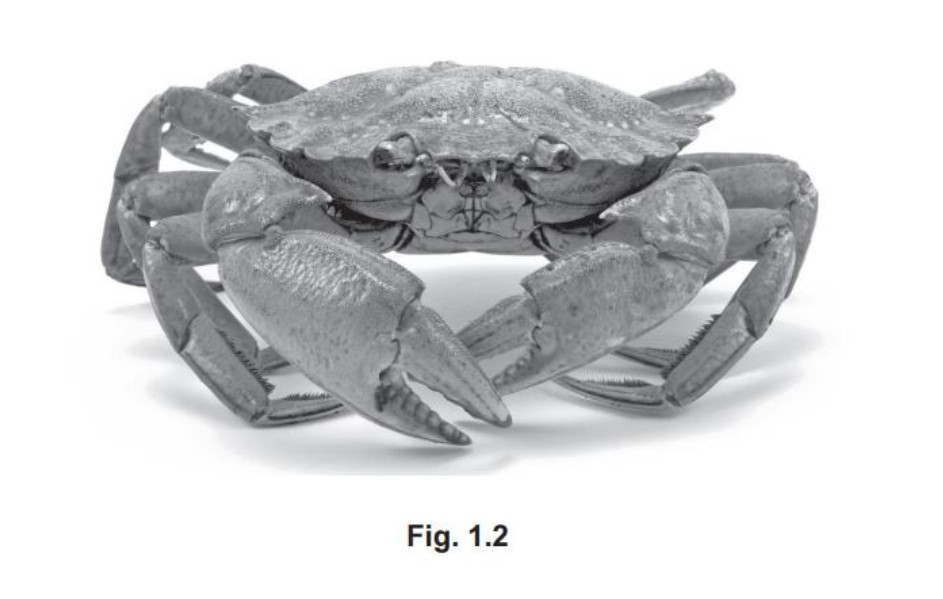
(i) State one adaptive feature visible in Fig. 1.2 that
reduces water loss when the organism is on land. [1]
(ii) State the name of the kingdom that the organism in Fig. 1.2 belongs to.
[1]
Question 3 — Cell Structure
Parts (a)–(c) • 10 marks total
(a)
Fig. 2.1 is a diagram showing some of the structures found in a plant cell.
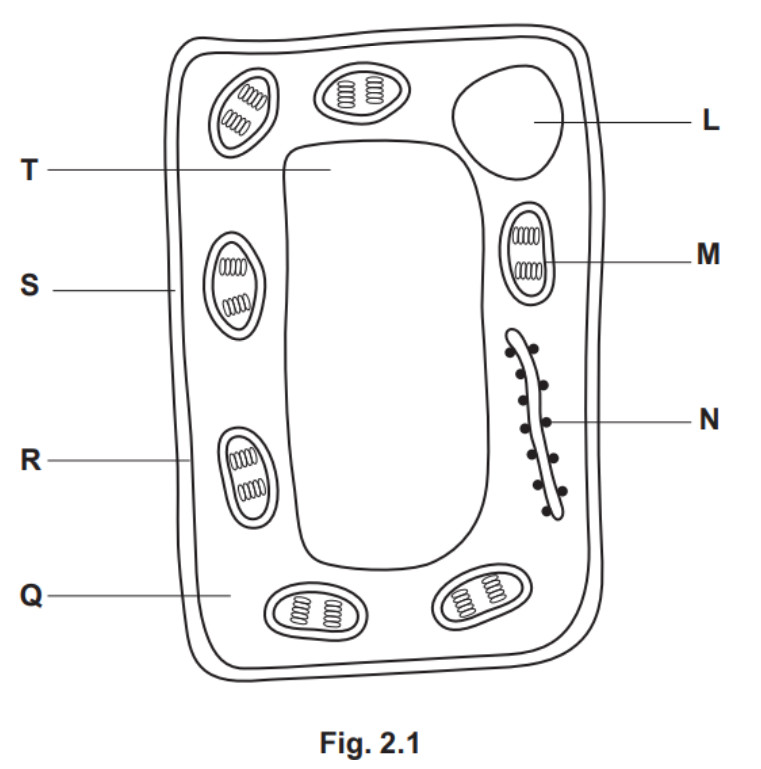 Table 2.1 shows the names of some plant cell structures, their functions and the letters that identify them
in Fig. 2.1. Complete Table 2.1 by writing the missing name, letters and functions in the spaces provided.
Table 2.1 shows the names of some plant cell structures, their functions and the letters that identify them
in Fig. 2.1. Complete Table 2.1 by writing the missing name, letters and functions in the spaces provided.
Table 2.1
| name of structure | letter from Fig. 2.1 | one function |
|---|---|---|
| chloroplast | site of photosynthesis | |
| ribosome | N | |
| cell wall | prevents the cell bursting | |
| L |
[5]
(b)
(i) State the name of one cell structure that is found in
plant cells but not in animal cells. [1]
(ii) State the name of one cell structure that is found in
plant cells and in animal cells. [1]
(c)
Fig. 2.2 is a diagram of a specialised plant cell.
State the name of the cell shown in Fig. 2.2 and describe how it is adapted for its function. [3]
IMAGE NEEDED: Diagram of a specialised plant cell (root hair cell) showing elongated hair-like projection and visible nucleus — Fig. 2.2
Crop from PDF: Page 7, Fig. 2.2


