
Homework – June 2026

Biology 0610 — Term 2 Exeat Work — Answers — June 2026
Question 1 — Osmosis in Potato Sticks
Parts (a)–(d)  •  10 marks total

Some students investigated osmosis in raw potato sticks. They placed each potato stick in one of four liquids (distilled water; 0.1, 0.5, or 1.0 mol per dm3 sodium chloride solution) for 5 hours, then measured the change in mass.

(a)
Define the term osmosis. [3]
Answer
Osmosis is the net movement of water molecules from a region of higher water potential (a more dilute solution) to a region of lower water potential (a more concentrated solution) through a partially permeable membrane.

Mark points (any 3 of the following):

  • Movement of water molecules (not just “water”) — 1 mark
  • Through a partially permeable membrane — 1 mark
  • From a region of higher water potential (more dilute / hypotonic) — 1 mark
  • To a region of lower water potential (more concentrated / hypertonic) — 1 mark
Exam tip: Always specify that it is water molecules that move, not just “water” or “particles”. The membrane must be described as partially permeable (not just “permeable”). The direction must be stated: from high to low water potential. All three elements are needed for full marks.
(b)(i)
Predict which of the liquids would cause the largest decrease in mass of a potato stick. [1]
Answer
1.0 mol per dm3 sodium chloride solution

This solution has the lowest water potential of the four liquids. The difference in water potential between the potato cells and the solution is greatest, so the most water moves out of the cells by osmosis, causing the largest loss in mass.

(b)(ii)
The students dried the potato sticks with paper towels before putting them on the electronic balance. Suggest why. [1]
Answer
To remove surface liquid so that only the mass of the potato itself is measured, giving an accurate result.

Any solution remaining on the surface of the potato would add to the reading on the balance. Drying removes this excess liquid so the mass recorded is due only to the potato tissue, making the measurement accurate and the results valid for comparison.

Exam tip: The key word here is accuracy — surface liquid would cause the recorded mass to be higher than the true mass of the potato, making the calculated change in mass unreliable.
(c)
After the experiment the students noticed that the potato stick with the lowest mass was soft and floppy. Explain why the potato stick had become soft and floppy. [3]
Answer
The potato stick with the lowest mass was in the most concentrated NaCl solution (1.0 mol per dm3), which had a lower water potential than the cell contents. Water moved out of the potato cells by osmosis through the partially permeable cell membranes. As water left the cells, the vacuoles shrank, the cells lost their turgor pressure and became flaccid. Without turgor pressure pushing outwards against the cell walls, the cells — and therefore the whole potato tissue — could no longer maintain their rigidity, becoming soft and floppy.

Mark points (any 3 of the following):

  • The solution had a lower water potential than the cell contents — 1 mark
  • Water moved out of the cells by osmosis (through partially permeable membrane) — 1 mark
  • Cells lost turgor pressure / became flaccid / became plasmolysed — 1 mark
  • Without turgor, the tissue could not support itself / became soft and floppy — 1 mark
Exam tip: In a turgid plant cell, the large vacuole is full of water and pushes outwards on the cell wall — this pressure is called turgor pressure and it makes plant tissues firm. When water leaves by osmosis, cells become flaccid and the tissue loses its structural support. Severe water loss leads to plasmolysis, where the cell membrane pulls away from the cell wall entirely.
(d)
The students followed the same experimental procedure with boiled potato sticks and found no overall change in mass in any of the solutions. Suggest why the mass of the boiled potato sticks remained the same. [2]
Answer
Boiling kills the cells and denatures / destroys the cell membranes. Because the cell membranes are no longer partially permeable (they are no longer intact), osmosis cannot occur and water cannot move in or out of the cells. Therefore the mass stays the same.

Mark points (both needed for 2 marks):

  • Boiling kills / denatures the cells, destroying the cell membranes so they are no longer partially permeable — 1 mark
  • Without a partially permeable membrane, osmosis cannot occur, so no water moves in or out — 1 mark
Exam tip: Osmosis depends entirely on the cell membrane being partially permeable. Boiling denatures the proteins that form this membrane, destroying its selective permeability. This is why boiling is used as a control in osmosis experiments — it confirms that any mass change in the raw potato sticks is due to osmosis through living cell membranes, not some other process.
Question 2 — Classification and Arthropods
Parts (a)–(c)  •  11 marks total
(a)
Describe the meaning of the term species. [2]
Answer
A species is a group of organisms that share similar characteristics and are able to interbreed (mate) with each other to produce fertile offspring.

Mark points (both needed for 2 marks):

  • A group of organisms that share similar / common characteristics — 1 mark
  • Able to interbreed to produce fertile offspring — 1 mark
Exam tip: The key word is fertile offspring. Different species can sometimes interbreed (e.g. horse × donkey = mule) but the offspring are infertile — so they do not belong to the same species. Always include “fertile” in your definition.
(b)(i)
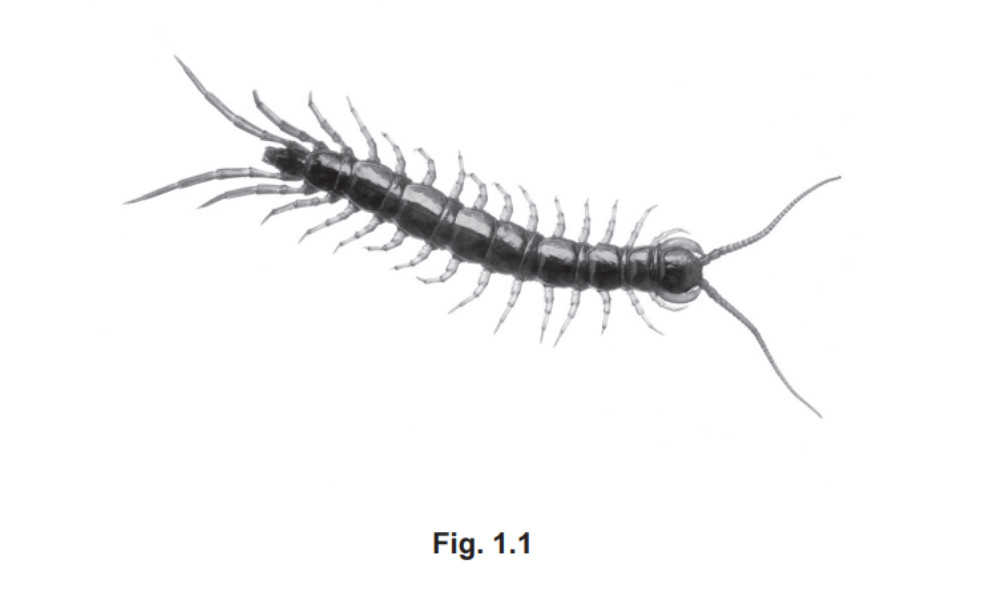
Fig. 1.1 is a photograph of Lithobius forficatus, a species of myriapod.
State the genus of the organism shown in Fig. 1.1. [1]
Answer
Lithobius

In binomial nomenclature, the scientific name has two parts: the genus (first word, capitalised) and the species (second word, lower case). For Lithobius forficatus, the genus is Lithobius.

Exam tip: The genus name is always the first word of the binomial name and is written with a capital letter. The species name (epithet) is always lower case. Both are written in italics.
(b)(ii)
State one feature visible in Fig. 1.1 that identifies the organism as a myriapod, and one visible feature that identifies it as an arthropod. [2]
Answer
As a myriapod:
Many (more than 4) pairs of legs / numerous pairs of legs (one pair per body segment)
As an arthropod:
Jointed legs  •  OR  •  Segmented body  •  OR  •  Hard exoskeleton (outer covering)
Exam tip: The question asks for features visible in the photograph, so your answer must be something that can actually be seen in the image. “Many pairs of legs” is clearly visible for myriapods (myriad = many, pod = foot). For arthropods, the key visible features are jointed legs and a segmented body — all arthropods share these features.
(b)(iii)
State the names of two groups of arthropods, other than myriapods. [2]
Answer
1. Insects (Insecta)
2. Arachnids (Arachnida)  •  OR  •  Crustaceans (Crustacea)

The four main groups of arthropods are:

  • Insects — 3 pairs of legs, 3 body sections, e.g. butterfly, bee, ant
  • Arachnids — 4 pairs of legs, 2 body sections, e.g. spider, scorpion, tick
  • Crustaceans — more than 4 pairs of legs, hard exoskeleton, e.g. crab, lobster, shrimp
  • Myriapods — many pairs of legs, e.g. centipede, millipede
Exam tip: Any two of the three listed above (insects, arachnids, crustaceans) are accepted. “Insect” and “arachnid” are the most commonly tested. Learn the distinguishing feature of each group.
(b)(iv)
State two features of plant cells that would be absent in the cells of the organism shown in Fig. 1.1. [2]
Answer
1. Cell wall (cellulose cell wall)
2. Chloroplast

Accept any two of:

  • Cell wall (made of cellulose) — animal cells have no cell wall
  • Chloroplast — not present in animal cells; the centipede cannot photosynthesise
  • Large permanent vacuole — plant cells have a large central vacuole; animal cells may have small temporary vacuoles only
Exam tip: Do not say “vacuole” without the qualifier “large permanent” — animal cells can have small vacuoles. The three structures unique to plant cells are: cell wall, chloroplasts, and large permanent vacuole. All three are absent in animal cells (and in the cells of animals such as centipedes).
(c)(i)
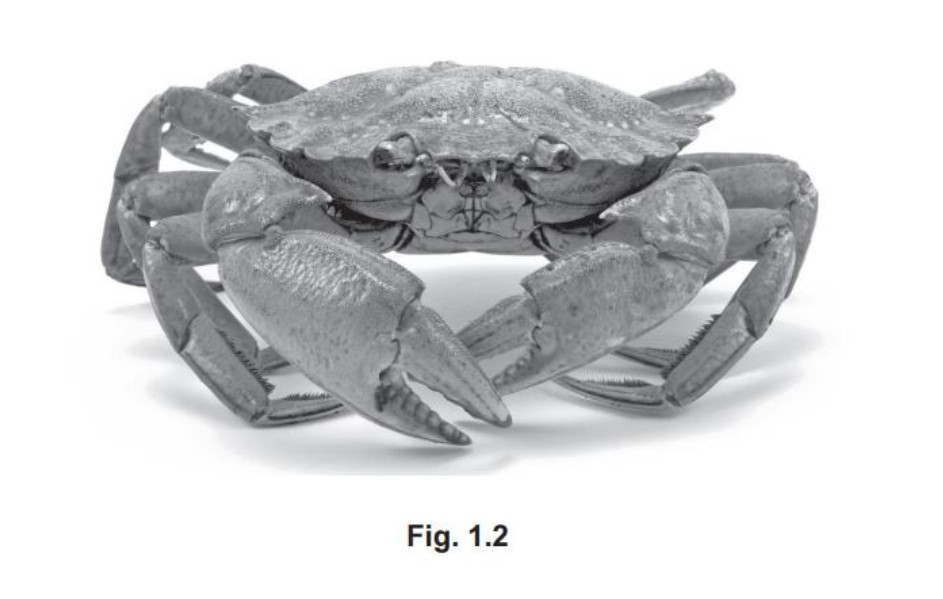
Fig. 1.2 is a photograph of another species of arthropod (a crab). State one adaptive feature visible in Fig. 1.2 that reduces water loss when the organism is on land. [1]
Answer
Hard exoskeleton / waterproof outer shell / hard cuticle

The crab’s hard exoskeleton is made of chitin and is largely waterproof. This prevents water from evaporating from the body surface when the crab is on land, helping it survive out of water.

Exam tip: The question specifies “visible in Fig. 1.2” — the hard exoskeleton/shell is clearly visible in a photograph of a crab. Other adaptations such as behavioural ones (e.g. seeking shade) would not be visible in a photograph and would not be credited here.
(c)(ii)
State the name of the kingdom that the organism in Fig. 1.2 belongs to. [1]
Answer
Animalia (Animal kingdom)

Crabs are multicellular organisms that cannot photosynthesise. They have cells with no cell wall and no chloroplasts, and they feed by consuming other organisms (heterotrophs). All of these features place them in the kingdom Animalia.
Exam tip: The five kingdoms are: Animalia, Plantae, Fungi, Protoctista, and Prokaryota. Crabs (arthropods) belong to Animalia. Either “Animalia” or “Animal kingdom” is accepted.
Question 3 — Cell Structure
Parts (a)–(c)  •  10 marks total
(a)
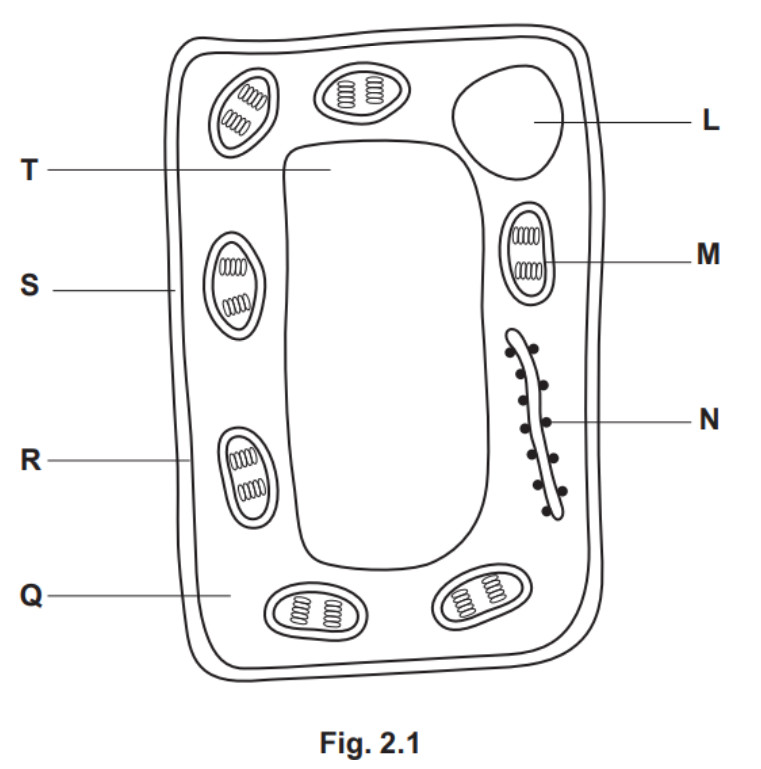
Fig. 2.1 is a diagram showing some of the structures found in a plant cell. Complete Table 2.1 by writing the missing name, letters and functions in the spaces provided.
[5]
Answer

Completed Table 2.1 (answers shown in blue):

name of structure letter from Fig. 2.1 one function
chloroplast M site of photosynthesis
ribosome N site of protein synthesis
cell wall T prevents the cell bursting
nucleus L contains genetic material (DNA) / controls cell activities

Mark scheme (1 mark per correct entry, max 5):

  • Chloroplast → letter M — 1 mark
  • Ribosome function: site of protein synthesis (makes proteins) — 1 mark
  • Cell wall → letter T — 1 mark
  • Letter L → name: nucleus — 1 mark
  • Letter L → function: contains genetic material / controls cell activities — 1 mark
Exam tip: The cell wall (T, outer boundary) is made of cellulose; it is rigid and prevents the cell from bursting when turgid. The nucleus (L, large circular structure) contains chromosomes (DNA) and controls all cell activities by directing protein synthesis. Ribosomes (N, small structures) are the sites where proteins are assembled from amino acids. Chloroplasts (M, green oval structures) contain chlorophyll and are where photosynthesis takes place.
(b)(i)
State the name of one cell structure that is found in plant cells but not in animal cells. [1]
Answer
Cell wall  •  OR  •  Chloroplast  •  OR  •  Large permanent vacuole

Any one of the above is accepted. These three structures are found in plant cells but are absent from animal cells.

(b)(ii)
State the name of one cell structure that is found in plant cells and in animal cells. [1]
Answer
Cell membrane  •  OR  •  Nucleus  •  OR  •  Mitochondrion  •  OR  •  Ribosome  •  OR  •  Cytoplasm

Any one of the above is accepted. These structures are present in both plant and animal cells.

Exam tip: A useful way to remember this:
  • Plant only: cell wall, chloroplast, large permanent vacuole
  • Both plant and animal: cell membrane, nucleus, cytoplasm, mitochondria, ribosomes
  • Animal only: (none unique — animal cells simply lack the three plant-only structures)
(c)
Fig. 2.2 is a diagram of a specialised plant cell. State the name of the cell shown in Fig. 2.2 and describe how it is adapted for its function.

IMAGE NEEDED: Diagram of specialised plant cell (root hair cell) with elongated hair-like projection and nucleus — Fig. 2.2

Crop from PDF: Page 7, Fig. 2.2

[3]
Answer
Name of cell:
Root hair cell
How it is adapted for its function:

Root hair cells are found on the surface of plant roots and are specialised for absorbing water and mineral ions from the soil.

Mark points (name = 1 mark; any 2 adaptations from the following = 2 marks):

  • Long, thin extension (root hair) greatly increases the surface area of the cell, allowing more water and minerals to be absorbed at the same time — 1 mark
  • Thin cell wall allows water and dissolved minerals to pass into the cell rapidly — 1 mark
  • Large vacuole with a low water potential helps draw water in by osmosis — 1 mark
  • Many mitochondria provide energy (ATP) for the active transport of mineral ions against a concentration gradient — 1 mark
  • No chloroplasts — root hair cells are underground and receive no light; this is an expected absence, not an adaptation for absorption per se
Exam tip: Always state the name of the cell first (1 mark), then link each adaptation to its function. The most important and most commonly examined adaptation is the long root hair extension → increased surface area → faster absorption. Mentioning “surface area” explicitly is essential for the mark.

Powered by BetterDocs

Leave a Reply

Your email address will not be published. Required fields are marked *

*